
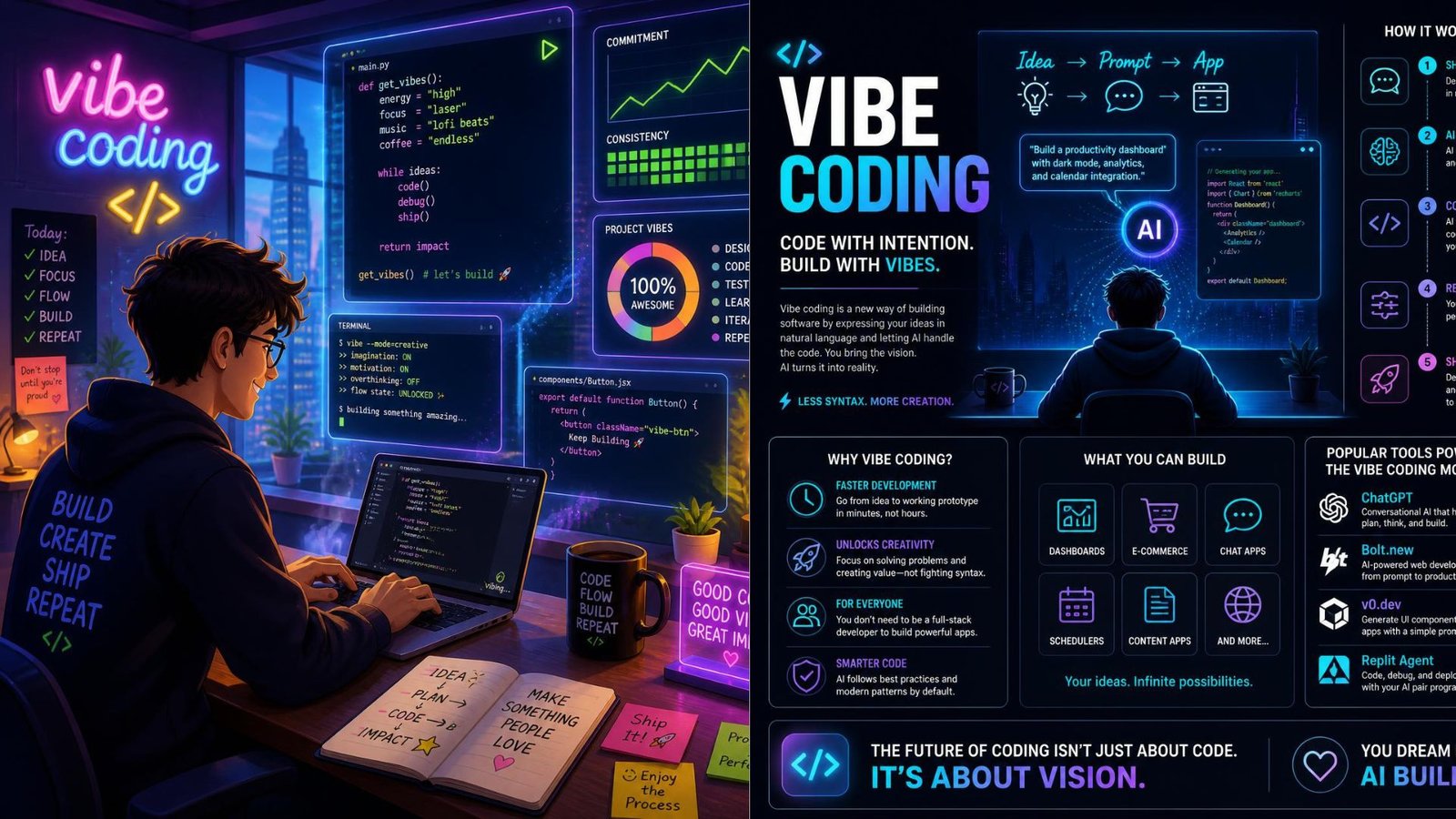
Software engineering is undergoing a radical transformation, moving away from manual syntax writing toward intent-driven creation. At the center of this cultural shift is what is vibe coding, a concept defining how modern creators build software using conversational natural language. Instead of typing every bracket and semicolon by hand, programmers act as directors, guiding advanced large language models to manifest entire digital systems.
This emerging methodology alters how technical and non-technical teams approach product design. By focusing entirely on high-level logic, user experience, and rapid iteration, creators can turn abstract ideas into working prototypes within minutes. Understanding what is vibe coding helps teams evaluate how artificial intelligence reshapes daily technical workflows and speeds up software delivery.
Understanding the Core Mechanics of Vibe Coding
The term originated to describe a state where developers rely completely on artificial intelligence agents to handle code generation. You supply the high-level creative vision, and the language model writes, organizes, and refines the underlying system architecture. Rather than getting bogged down by compilation errors, you maintain momentum through prompt iterations.
| Development Style | Primary Focus | Execution Method | Common Use Case |
| Traditional Coding | Syntax, structure, and manual compilation | Line-by-line coding in an integrated development environment | Enterprise software requiring strict compliance |
| Vibe Coding | High-level logic, flow, and rapid iteration | Conversational prompting and AI code generation | Rapid prototyping, MVPs, and personal projects |
Examining what is vibe coding reveals that conversational programming bridges the gap between imagination and execution. Instead of learning complex syntax rules, humans communicate goals natively.
| Feature Area | Traditional Approach | Modern Approach | Value Proposition |
| Input Format | Programming Language | Natural Language | Lower Barrier to Entry |
| Output Speed | Manual/Slow | Instant/Automated | Faster Time-to-Market |
When analyzing what is vibe coding, it is essential to see how these two paradigms contrast in modern development environments. The shift toward what is vibe coding signifies that logic is becoming more valuable than syntax. Implementing what is vibe coding requires developers to master the art of contextual prompting. As we explore what is vibe coding, the focus remains on user-centric output.
The Shift from Syntax to Intent
For decades, mastering a programming language was a mandatory barrier to entry for building digital tools. Today, natural language functions as the primary interface.
- Natural Language Prompts: Describe application features, user interfaces, or database queries in plain English.
- Autonomous Generation: Advanced large language models construct multi-file structures and execute terminal commands automatically.
- Iterative Refinement: Review live application outputs, isolate friction points, and issue follow-up instructions to steer the final product.
💡 Pro Tip: Break large application requests into smaller, incremental prompt chains to prevent the AI model from losing contextual awareness or introducing messy code structures.
Benefits and Real-World Limitations
While this conversational style drastically accelerates prototyping, it introduces unique engineering challenges. Teams must balance speed with maintainability.
- Accelerated Velocity: Spin up fully functional user interfaces and back-end logic in a fraction of traditional timelines.
- Reduced Cognitive Load: Minimize burnout associated with tracking minor syntax rules and boilerplate code.
- Security and Maintenance Risks: Over-reliance on unverified code can introduce hidden vulnerabilities if developers fail to audit outputs.
Understanding what is vibe coding effectively requires constant vigilance. Whether you apply what is vibe coding to small scripts or large projects, safety is key. Many developers find that what is vibe coding improves their overall efficiency. Even when what is vibe coding feels intuitive, manual review is necessary.
📌 Key Takeaway: While understanding what is vibe coding democratizes software creation and supercharges productivity, balancing speed with rigorous code review ensures long-term application stability.
Conclusion
Ultimately, understanding what is vibe coding highlights a fundamental evolution in software engineering. By letting creators focus on user experience and product vision while artificial intelligence handles raw syntax, building innovative digital products has never been more accessible through what is vibe coding techniques.
Frequently Asked Questions
1.Who coined the term vibe coding?
The concept and term were popularized by computer scientist and artificial intelligence researcher Andrej Karpathy. He used the phrase to describe a workflow where programmers immerse themselves in the creative flow of a project while artificial intelligence manages the burden of writing underlying syntax.
2.Do I need to know how to program to use this method?
You do not need an extensive background in computer science or syntax memorization to build functional tools. However, having a foundational understanding of logic, debugging principles, and software architecture helps you guide the artificial intelligence assistant more effectively and catch critical errors.
3.What tools support this style of development?
Several modern integrated development environments and agentic platforms facilitate conversational programming. Popular options include Cursor, Replit Agent, GitHub Copilot Workspace, Windsurf, and bolt.new, all of which offer deep workspace memory and multi-file reasoning capabilities.
4.How does this approach impact software security?
Because code is generated instantly through conversational prompts, security flaws or outdated dependencies can slip past casual review. Developers must implement rigorous testing protocols, code reviews, and automated vulnerability scans before pushing any prototype into a live production environment.
