

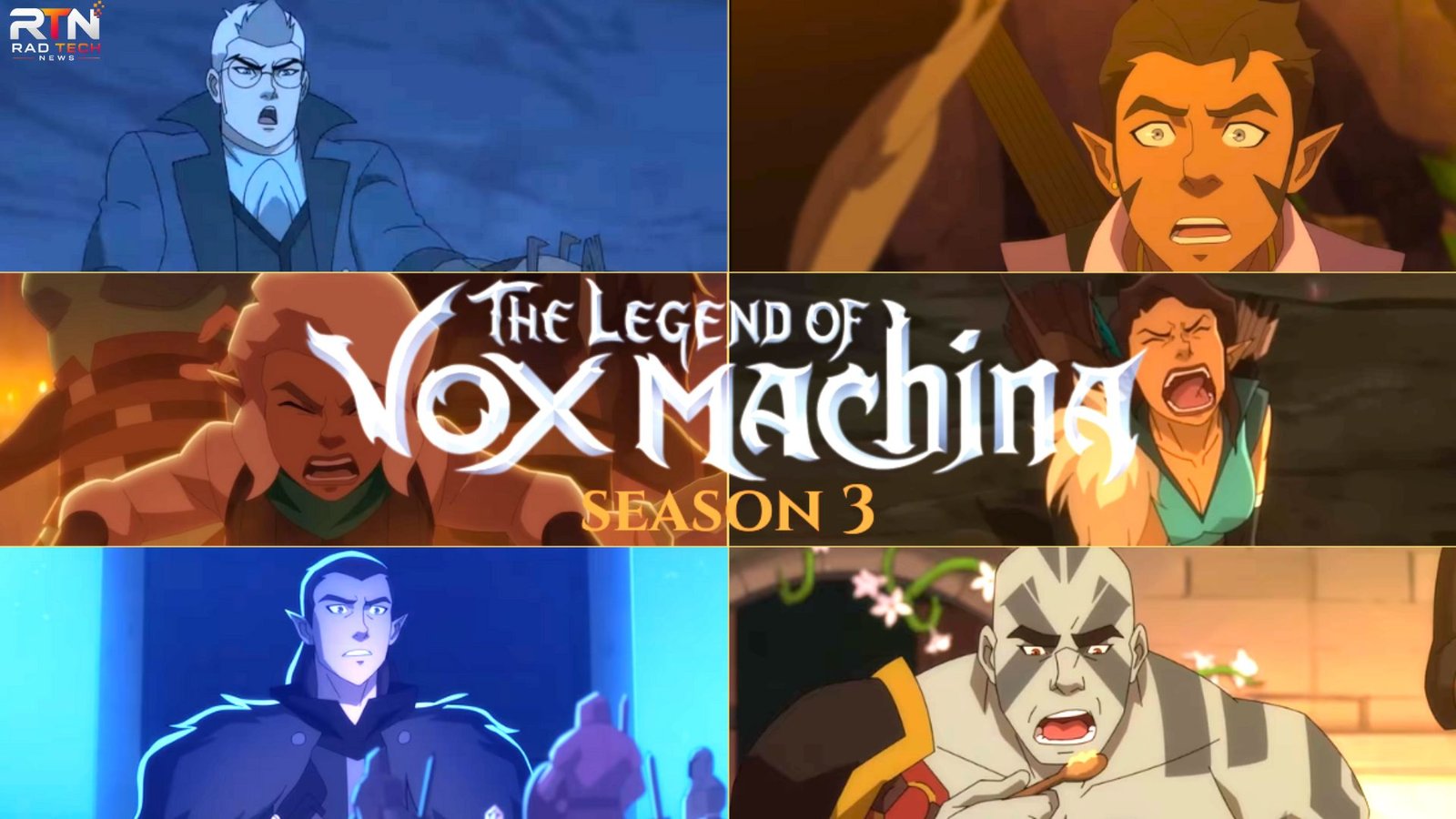
If you finished the first two seasons of The Legend of Vox Machina, Season 3 arrives with a different kind of pressure. The party is no longer simply trying to prove that they belong together; they are dealing with enemies powerful enough to threaten the entire world. That makes understanding The Legend of Vox Machina Season 3 especially useful for viewers who want to know what happens, why the season matters, and how it changes the characters.
Season 3 continues Vox Machina’s struggle against the Chroma Conclave while pushing the story into darker emotional territory. The dragons remain a major threat, but the most interesting developments often come from the characters themselves. Percy, Vex’ahlia, Vax’ildan, Keyleth, Scanlan, Pike, and Grog each face consequences that are more personal than the battles alone suggest.
What Is The Legend of Vox Machina Season 3 About?
Season 3 continues the campaign against the Chroma Conclave, the group of ancient dragons that has already demonstrated how badly it can overwhelm Vox Machina.
After the events of Season 2, the heroes understand that defeating these dragons will require more than courage. They need greater power, better preparation, and a willingness to confront parts of themselves they have previously avoided.
The season therefore works on two levels:
- The external conflict: Vox Machina must survive and fight increasingly dangerous enemies.
- The internal conflict: Each member has to confront fear, guilt, temptation, responsibility, or personal loss.
This balance is one of the season’s strongest features. The dragons provide the large-scale fantasy spectacle, while the characters give the story its emotional weight.
Do You Need to Watch the First Two Seasons?
Yes. Season 3 is much easier to appreciate if you have watched Seasons 1 and 2.
The series does not treat its characters as strangers at the beginning of every season. Their relationships, previous decisions, and emotional wounds continue to affect what happens.
For example, understanding Vax and Vex requires remembering how their relationship developed. Percy’s actions make more sense when viewed against his history with the Briarwoods. Keyleth’s storyline also depends heavily on the confidence and leadership struggles established earlier.
A quick refresher is enough if you have forgotten the details:
- Vox Machina began as an unreliable group of adventurers.
- They gradually became a genuine team.
- The Briarwood conflict forced them to confront their darker sides.
- The Chroma Conclave emerged as a much larger threat.
- Season 2 expanded the group’s relationships while introducing the major dragon conflict.
- Season 3 raises the personal cost of that battle.
The Chroma Conclave Becomes Even More Dangerous
One of the biggest strengths of Season 3 is that the dragons do not feel like ordinary fantasy villains.
The Chroma Conclave represents overwhelming power. Vox Machina cannot simply walk into a battle and expect to win because they are the heroes. They need strategy, allies, artifacts, and sometimes difficult compromises.
This creates a useful contrast with earlier adventures.
In the beginning, the group often survives through improvisation. By Season 3, improvisation alone is no longer enough. Their enemies operate on a scale where a single mistake can have catastrophic consequences.
That change also makes the heroes’ growth easier to see.
They are becoming stronger, but greater strength does not automatically make them safer.
Character Development Is the Real Story
The action may attract viewers, but character development is what gives Season 3 its staying power.
Percy and Vex’ahlia
Percy and Vex continue to have one of the show’s most complicated relationships.
Percy’s intelligence and confidence can sometimes hide how deeply his past affects him. Vex, meanwhile, is often practical and composed, but her confidence does not mean she is emotionally invulnerable.
Their relationship works because the show does not reduce it to a simple romance. They have disagreements, fears, and different ways of dealing with danger.
One subtle strength of their storyline is that affection becomes more meaningful when the characters are forced to make decisions under pressure.
Vax’ildan and Keyleth
Vax and Keyleth’s relationship receives considerable emotional attention.
Their connection is complicated by Vax’s increasing awareness of forces larger than himself and Keyleth’s ongoing struggle with responsibility.
Keyleth is particularly important in Season 3 because her development is no longer just about becoming more confident. She increasingly has to think like someone capable of leading others.
That is a major distinction.
Being powerful is one thing. Knowing when and how to use that power is another.
Scanlan
Scanlan’s storyline is one of the more emotionally surprising aspects of the season.
Earlier episodes often use him as comic relief, but the series has gradually revealed that the humor is sometimes a shield. Season 3 continues pulling back that shield.
His desire to be recognized, loved, and understood becomes increasingly important.
This is one reason his scenes can hit harder than expected: the audience has spent so much time laughing at Scanlan that it can be easy to forget how much insecurity sits underneath the jokes.
Grog
Grog remains one of the group’s most entertaining members, but Season 3 continues showing that his simplicity should not be confused with stupidity.
His loyalty is one of his greatest strengths.
He may not approach problems the way Percy or Keyleth does, but he understands friendship and physical courage in a very direct way. His relationship with the rest of Vox Machina helps keep the group grounded when the story becomes increasingly serious.
Pike
Pike’s role remains closely connected to faith, friendship, and responsibility.
Her abilities make her extremely valuable to the team, but her importance is not limited to healing or magical support. She frequently acts as an emotional stabilizer for the group.
That becomes especially important when Vox Machina’s personal conflicts begin interfering with their larger mission.
Why Season 3 Feels Darker
Season 3 does not simply increase the number of battles. It increases the consequences of those battles.
Earlier episodes often had the feeling of an adventure that could eventually return to normal. Season 3 increasingly removes that comfort.
Characters have more to lose.
The enemies are stronger.
The decisions are harder.
And victories can carry consequences of their own.
This darker atmosphere also fits the original Critical Role campaign material on which the animated series is based. The show has adapted that material rather than reproducing it scene for scene, allowing it to restructure events for television pacing and character development.
A Major Difference From the Original Campaign
One of the most interesting things for longtime Critical Role fans is comparing the animated adaptation with the source campaign.
The television series cannot simply recreate hours of tabletop sessions. It has to compress storylines, combine scenes, adjust pacing, and sometimes change how characters reach the same narrative destination.
That means viewers familiar with the campaign should not assume that every event will happen exactly as they remember it.
This creates a useful viewing experience:
Campaign knowledge can add context, but it should not replace watching the animated story on its own terms.
For new viewers, this is good news. You do not need to know Critical Role to understand Vox Machina.
What Makes Season 3 Worth Watching?
There are three particularly strong reasons.
1. The characters finally feel tested
The members of Vox Machina have become powerful adventurers, but Season 3 asks whether they can remain a team when their individual problems become impossible to ignore.
2. The fantasy world feels larger
The story expands beyond simple dungeon-style adventure. Political consequences, ancient powers, magical artifacts, dragons, and personal histories all become interconnected.
3. The emotional stakes match the action
A spectacular fight works better when the viewer understands what the characters could lose.
Season 3 generally succeeds because the battles are connected to personal stakes rather than existing only for spectacle.
Three Details Viewers May Miss
The group is strongest when their abilities complement each other
Vox Machina is not simply a collection of individually powerful characters. Their effectiveness comes from combining completely different personalities and abilities.
The best victories often depend on cooperation rather than one hero defeating everyone alone.
Humor is used as emotional protection
The comedy is not merely there to lighten the mood.
Scanlan, Grog, and even other members of the group often use humor to cope with fear or uncertainty. When the jokes disappear, the emotional shift can be more revealing than a dramatic speech.
Power repeatedly creates new problems
A common fantasy pattern is that heroes become stronger and therefore safer.
Vox Machina often experiences the opposite.
New abilities can attract attention, create responsibility, or tempt characters toward decisions they might otherwise avoid. Season 3 uses that idea particularly well.
Common Mistakes When Watching Season 3
A few viewing habits can make the season less satisfying.
Mistake 1: Focusing only on the dragons.
The Chroma Conclave is the obvious central threat, but the character arcs explain why the conflict matters.
Mistake 2: Expecting every character to behave rationally.
These characters are shaped by fear, history, affection, and insecurity. Their emotional decisions are often intentional parts of the story.
Mistake 3: Assuming the campaign and series are identical.
The animated adaptation makes changes. Treating every difference as an error can distract from what the television version is trying to accomplish.
Mistake 4: Skipping emotional scenes because they slow the action.
Some of the most important developments happen away from combat.
How Season 3 Changes Vox Machina
By the end of the season, the group is no longer the same collection of adventurers introduced at the beginning of the series.
They have experienced enough loss and danger to understand that being heroes carries permanent consequences.
Their relationships become deeper, but also more complicated. Leadership becomes more important. Individual choices have greater effects on everyone else.
Most importantly, the season reinforces a central idea of The Legend of Vox Machina: strength is not simply about having better weapons or more powerful magic.
It is about deciding what you are willing to protect when everything becomes difficult.
Is The Legend of Vox Machina Season 3 Good?
For viewers who enjoyed the first two seasons, Season 3 is a strong continuation rather than a reset.
Its biggest success is the way it combines large-scale fantasy with personal storytelling. The dragons provide the immediate danger, but the characters provide the reason to care.
It also rewards viewers who pay attention to relationships. A conversation between two characters can sometimes be as important as an entire fight sequence because it changes how they approach the next challenge.
The season is not perfect, particularly for viewers who prefer slower world-building or who find the frequent tonal shifts between comedy and serious fantasy distracting. But that mixture is also part of the show’s identity.
Frequently Asked Questions
Is The Legend of Vox Machina Season 3 based on Critical Role?
Yes. The animated series is based on the first major campaign of Critical Role, although the television adaptation changes, condenses, and rearranges material for its format. You can enjoy Season 3 without having watched the tabletop campaign.
What is the main story of The Legend of Vox Machina Season 3?
The season continues Vox Machina’s conflict with the Chroma Conclave while developing the characters’ personal struggles. The heroes must become stronger and work together while dealing with increasingly serious consequences.
Is Season 3 darker than Season 2?
Yes, in several ways. The danger becomes more personal, and the consequences of the characters’ choices become more significant. However, the series still retains its trademark humor and lighter character interactions.
Do I need to watch Season 1 and Season 2 before Season 3?
It is strongly recommended. Season 3 builds directly on earlier relationships, conflicts, and character development, so watching from the beginning provides much more emotional context.
Who are the main characters in Season 3?
The core Vox Machina members include Vex’ahlia, Vax’ildan, Percy, Keyleth, Scanlan, Pike, and Grog. Their individual stories continue to intersect as the group faces the Chroma Conclave and its wider consequences.
Is The Legend of Vox Machina worth watching if I have never played Dungeons & Dragons?
Absolutely. Knowledge of Dungeons & Dragons or Critical Role can add extra context, but neither is required. The series works as a fantasy adventure centered on a dysfunctional group of heroes who gradually become a genuine family.
Final Thoughts
The Legend of Vox Machina Season 3 works because the dragon conflict is only part of the story. Beneath the magic, battles, jokes, and fantasy world-building is a group of flawed people trying to protect one another while becoming the kind of heroes their situation demands.
The season’s most valuable quality is its understanding that character growth should have consequences. Vox Machina does not become stronger simply because the plot says they should. They grow through fear, mistakes, relationships, sacrifice, and difficult choices.
