

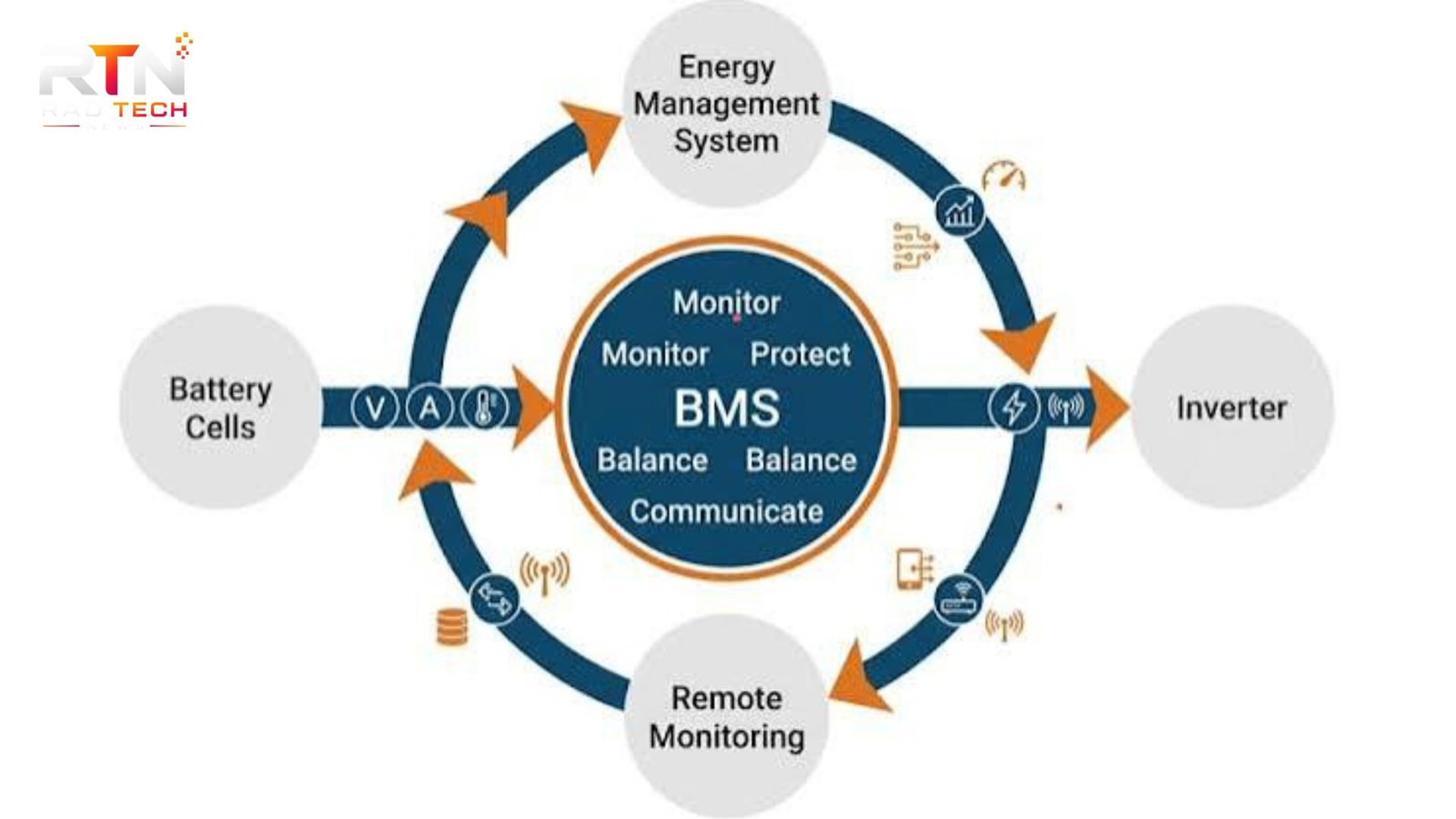
The BMS meaning depends on the context in which you encounter the abbreviation. In technology and engineering, BMS most commonly refers to a Battery Management System or Building Management System. The first monitors and protects rechargeable batteries, while the second controls and monitors equipment inside buildings. Other industries may use BMS for different terms, so context matters.
For someone searching for the BMS meaning, the quickest answer is to identify where the abbreviation appears. A battery specification, electric vehicle, or energy-storage discussion usually points to Battery Management System. A commercial property, HVAC, or building-automation discussion usually means Building Management System.
What Does BMS Mean?
BMS is an abbreviation with more than one established meaning. Two of the most important technical uses are:
- Battery Management System: An electronic control system that monitors and manages rechargeable batteries.
- Building Management System: A computer-based system that monitors and controls building services and equipment.
The U.S. National Institute of Standards and Technology (NIST) lists both Battery Management System and Building Management Systems among the meanings associated with BMS.
That distinction is useful because the same three letters can describe completely different technologies.
BMS Meaning in Batteries
In the battery industry, BMS stands for Battery Management System. It is particularly important for rechargeable battery packs containing multiple cells, including lithium-ion batteries used in electric vehicles, portable electronics, and energy-storage systems.
A battery management system monitors measurements such as cell voltage, current, and temperature. It can also estimate conditions such as state of charge (SoC) and state of health (SoH), while controlling charging and discharging within defined operating limits.
What Does a Battery BMS Do?
A battery BMS performs several jobs at once:
- Monitors cells: It tracks voltage and temperature and monitors current flowing through the battery.
- Protects the battery: It can help prevent unsafe overvoltage, undervoltage, overcurrent, and excessive-temperature conditions.
- Balances cells: In multi-cell packs, balancing helps manage differences between individual cells.
- Estimates battery condition: The system can calculate or estimate remaining charge and battery health.
- Communicates information: More advanced systems report battery status, warnings, and faults to another controller or device.
These functions help a battery operate within appropriate limits while making better use of its available energy.
| BMS use | Main purpose | Typical example |
|---|---|---|
| Battery Management System | Monitor, protect, and manage rechargeable batteries | EV battery pack |
| Building Management System | Monitor and control building services | Office HVAC system |
| Building Automation System | Automate building operations | Commercial building controls |
💡 Pro Tip: If you see BMS in an electric-vehicle, solar-storage, e-bike, or battery-pack specification, look for references to cell voltage, temperature, SoC, SoH, or balancing. Those terms are strong indicators that BMS means Battery Management System.
BMS Meaning in Buildings
In commercial property and facilities management, BMS commonly means Building Management System. It is a computer-based control system used to monitor and manage mechanical and electrical services throughout a building.
A building BMS may control or monitor heating, ventilation and air conditioning (HVAC), lighting, power systems, security, fire-related systems, and other building equipment. Modern systems can bring information from multiple services into a centralized interface.
For example, an office building could use sensors to detect temperature and occupancy. The BMS can use that information to adjust HVAC operation according to configured settings. Facility managers can also use system data and alarms to identify equipment problems or unusual conditions.
The U.K. government describes BMS technology as systems that automatically manage building systems and notes that they can support functions such as energy monitoring, equipment management, and remote access.
Why Are Building Management Systems Used?
A building management system can provide:
- Centralized monitoring of building equipment
- Automated control of HVAC and lighting
- Equipment status and fault alerts
- Energy-use monitoring
- Scheduling and control based on configured conditions
- Greater visibility for facility managers
The exact capabilities vary according to the building, installed equipment, software, sensors, and control architecture.
How Do You Know Which BMS Meaning Applies?
Context usually provides the answer. Consider the words surrounding the abbreviation.
If the text mentions cells, charging, lithium-ion, voltage, current, SoC, SoH, or EVs, it almost certainly concerns a Battery Management System.
If it mentions HVAC, occupancy, lighting, energy consumption, sensors, facilities, or commercial buildings, it is probably referring to a Building Management System.
The distinction is especially important in technical documents. Assuming the wrong definition can lead to misunderstanding an entire specification or instruction.
Is BMS the Same as a Battery Protection Circuit?
Not necessarily. A basic protection circuit can provide limited functions such as protection against certain electrical conditions, while a more sophisticated Battery Management System can monitor multiple battery parameters, estimate battery state, balance cells, communicate information, and manage operating limits.
The architecture also depends on the size and complexity of the battery. A small consumer battery may use relatively simple electronics, whereas an electric-vehicle battery pack can require a more complex, hierarchical monitoring and control system.
BMS vs. BAS: Are They Different?
In building technology, BMS and BAS can refer to closely related concepts. BAS stands for Building Automation System, while BMS commonly means Building Management System.
The terminology varies by organization, region, and product. Schneider Electric, for example, describes a building management system as sometimes being called a building automation system.
The practical scope matters more than the abbreviation. A particular installation may integrate HVAC, lighting, security, fire systems, power monitoring, and other equipment under one platform.
📌 Key Takeaway
The BMS meaning is determined by context. In battery technology, it usually means Battery Management System, which monitors and protects rechargeable batteries. In commercial buildings, it usually means Building Management System, which monitors and controls building services. Checking the surrounding technical terms is the fastest way to identify the intended definition.
Frequently Asked Questions
What is the most common BMS meaning?
There is no single meaning in every industry. In battery and electric-vehicle technology, BMS usually means Battery Management System. In facilities and building automation, it commonly means Building Management System. The surrounding terminology normally makes the intended definition clear.
What does BMS mean in an electric vehicle?
In an electric vehicle, BMS generally means Battery Management System. It monitors battery conditions such as voltage, current, and temperature and helps manage charging, discharging, cell balancing, and battery-state information. Its role is particularly important because EV battery packs contain many interconnected cells.
What does BMS mean in HVAC?
In HVAC and facilities management, BMS generally means Building Management System. It can monitor and control heating, ventilation, and air-conditioning equipment, often alongside lighting, power, alarms, and other building systems. This provides facility operators with centralized information and automated control.
Is BMS only used for lithium-ion batteries?
No. Battery management technology is used with rechargeable battery systems more broadly, although the design and control requirements vary according to battery chemistry and application. Lithium-ion systems receive substantial attention because they require careful monitoring and protection within their specified operating conditions.
Why is a BMS important?
The reason depends on which system is being discussed. A battery BMS helps monitor, protect, and manage battery operation. A building BMS helps operators monitor and control building equipment. In both cases, the central idea is coordinated monitoring and control rather than simply displaying information.
Choosing the Right Definition
The best way to interpret BMS is to look at the subject surrounding the abbreviation. If the discussion involves batteries, EVs, charging, or energy storage, the intended BMS meaning is likely Battery Management System. If the discussion concerns HVAC, facilities, energy use, or building automation, it is likely Building Management System.
Understanding that distinction prevents confusion and makes technical information much easier to interpret. For most readers, the surrounding terminology provides enough evidence to identify the correct meaning without relying on the abbreviation alone.
Conclusion
The BMS meaning depends largely on the context. In battery technology, BMS usually refers to a Battery Management System that monitors, protects, and manages rechargeable battery packs. In commercial buildings, it generally means a Building Management System used to monitor and control systems such as HVAC, lighting, and energy equipment.
When you encounter the abbreviation, checking the surrounding technical terms is the simplest way to identify the correct definition. Understanding that distinction can prevent confusion and help you interpret product specifications, engineering documents, and building-automation information more accurately.
