

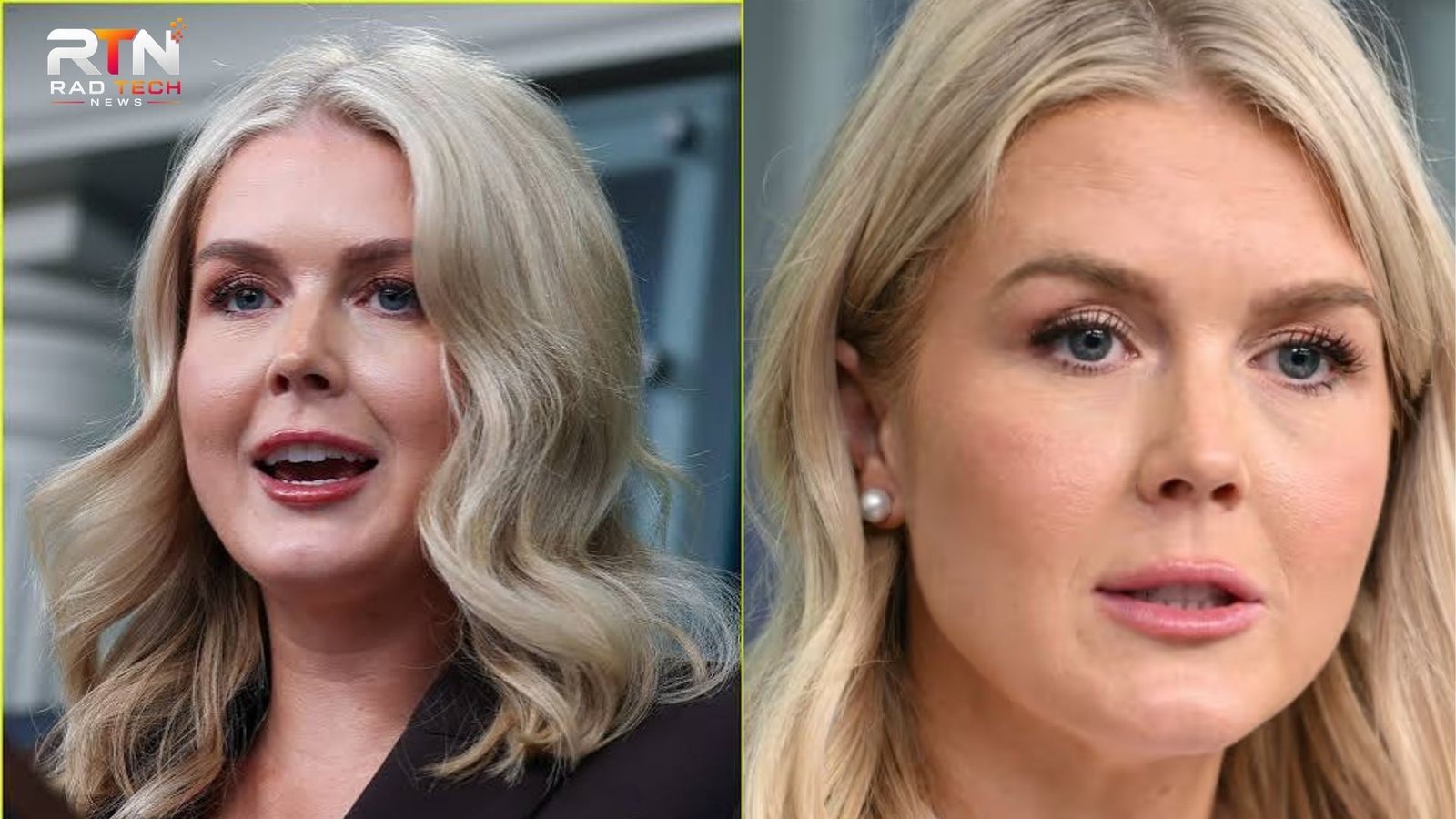
The Karoline Leavitt Vanity Fair photo became one of those political portraits that people discussed far beyond the original story. Instead of a polished official headshot, readers saw an unusually tight portrait that emphasized natural skin texture, makeup, facial details, and marks around Leavitt’s lips. Almost immediately, social media users began debating whether the photograph was revealing, deliberately unflattering, or simply more realistic than the highly controlled pictures people are used to seeing online.
That debate is more complicated than deciding whether someone “looked good” or “looked bad.” The portrait was part of a larger Vanity Fair project about President Donald Trump’s White House team and was photographed by Christopher Anderson, whose work regularly uses intimate, close-range portraiture.
Understanding the controversy therefore requires looking at three separate questions: what the photographer actually did, what viewers assumed they were seeing, and why an apparently straightforward portrait produced such a strong reaction.
Here is what we know, what remains speculation, and what the controversy tells us about political photography in the age of filters.
What Was the Karoline Leavitt Vanity Fair Photo?
The widely discussed portrait was photographed by Christopher Anderson as part of Vanity Fair’s December 2025 coverage of figures inside Trump’s second-term White House.
At the time, Karoline Leavitt was serving as White House press secretary. The broader project also featured figures including Vice President JD Vance, Secretary of State Marco Rubio, White House Chief of Staff Susie Wiles, and Stephen Miller.
What made Leavitt’s portrait stand out was its extreme proximity.
It was not presented like a traditional government portrait, where flattering lighting, careful distance, controlled expressions, and polished post-production usually create a clean public-facing result. Anderson moved physically close to his subjects and photographed facial details that ordinary political photography frequently minimizes.
According to Anderson, those tightly framed portraits were not simply enlarged or dramatically cropped afterward. He said he was standing extremely close while taking them.
That distinction matters because the closeness was part of the photographic approach from the beginning.
Why Did the Karoline Leavitt Vanity Fair Photo Go Viral?
Several factors collided at once.
The Portrait Was Unusually Close
Most people rarely see politicians photographed from that distance.
Official photographs, television appearances, campaign material, social posts, professional makeup, studio lighting, and modern phone processing all tend to create some distance between a person’s actual skin texture and the finished public presentation.
Anderson’s portrait removed much of that visual distance.
Skin texture, makeup details and tiny imperfections therefore became much more noticeable than viewers expected.
That alone created a reaction.
Attention Quickly Shifted to Her Lips
Much of the online discussion focused on small marks visible around Leavitt’s lips.
Commentators described them as appearing similar to cosmetic injection sites, and several media reports repeated that interpretation. Anderson himself was later directly questioned about the marks.
There is an important distinction here, however:
A photograph cannot establish someone’s cosmetic-treatment history with certainty.
It may show visible marks. People may interpret those marks as evidence of lip filler or another procedure. But declaring a particular medical or cosmetic procedure as fact based solely on visual appearance goes beyond what the photograph proves.
That distinction was frequently lost as the story spread.
It Challenged the Version of Public Figures People Usually See
The reaction also reveals something larger about modern media.
People have become accustomed to seeing public figures through:
- controlled lighting
- professional makeup
- smartphone processing
- beauty filters
- carefully selected social posts
- campaign photography
- television production
- professional retouching
When those layers disappear, a perfectly ordinary human face can suddenly appear unusually “raw.”
That does not necessarily mean the photograph itself is unusually harsh. Sometimes our baseline expectation has simply become unusually polished.
Who Took the Vanity Fair Portrait?
Christopher Anderson is an established photographer whose career includes documentary, political, editorial, and celebrity work.
His explanation of the White House assignment is particularly useful because it challenges the assumption that the unusual portraits happened accidentally.
Anderson said Vanity Fair approached him specifically for his journalistic perspective. He described his role as observing political power rather than approaching administration officials in the same way he might approach entertainment celebrities.
He also explained that the close portraits were only one part of the shoot.
He photographed officials through several approaches, including environmental portraits showing their offices, more conventional posed photographs, group portraits, candid moments, and extremely close facial studies.
Sessions generally lasted roughly 15 to 40 minutes per person.
That context is important.
The controversial Karoline Leavitt close-up was not the only photographic style used during the assignment. It was one choice within a much broader visual record.
Did Vanity Fair Intentionally Make Karoline Leavitt Look Bad?
This became one of the central questions surrounding the controversy.
The White House publicly criticized the photographs. A spokesperson argued that Vanity Fair intentionally photographed and edited administration officials in unusual ways intended to embarrass them.
Anderson rejected the idea that his goal was to make the subjects unattractive.
He pointed to his history of photographing political figures at very close range and said the approach was not limited to one political side. He described the objective as getting beyond what he sees as the “theater” surrounding political presentation.
Both positions should be separated from what can actually be established.
There is clear evidence that the portrait was deliberately close and deliberately revealing.
There is also clear evidence that Anderson consciously chose not to conceal certain visible details.
But deliberately choosing an unvarnished style is not automatically the same thing as digitally altering a person’s appearance to make them look worse.
No credible evidence presented around the controversy established that Vanity Fair artificially added the facial details that became the focus of discussion.
What Did Christopher Anderson Say About Leavitt’s Portrait?
When Vanity Fair later interviewed Anderson about the photographs, the magazine specifically asked him about the details visible around Leavitt’s lips.
His response was revealing.
Anderson said he did not support shaming people for their physical appearance, but argued that the way public figures present themselves can itself become part of what a portrait documents. He said he decided not to remove, minimize, or conceal what the camera captured.
That explanation moves the discussion away from beauty and toward editorial philosophy.
His position was essentially that a political portrait does not necessarily have an obligation to flatter its subject.
Critics, however, can reasonably ask another question: just because something can be shown in extreme detail, does choosing to emphasize it influence how the audience interprets that person?
The answer is clearly yes.
Photography always involves selection.
Unfiltered Does Not Automatically Mean Neutral
This is one of the most important points missing from many discussions of the Karoline Leavitt Vanity Fair photo.
A photograph can be authentic without being neutral.
Consider these two approaches:
| Polished Political Portrait | Anderson-Style Close Portrait |
|---|---|
| Comfortable camera distance | Extremely close distance |
| Soft or controlled lighting | Texture-preserving detail |
| Appearance carefully managed | Imperfections remain visible |
| Designed for public presentation | Designed for observation |
| Often emphasizes confidence | May emphasize vulnerability |
| Viewer notices the overall person | Viewer notices minute details |
Neither approach is automatically false.
But neither is entirely objective.
Camera distance, lighting, lens choice, expression, timing, framing and final photograph selection all influence what viewers feel.
Even deciding not to retouch something is an editorial decision when retouching is commonplace elsewhere.
That does not make the photograph dishonest. It simply means “unfiltered” and “neutral” are not synonyms.
Why the Reaction Says as Much About Us as the Photograph
One overlooked aspect of the controversy is the audience’s expectation.
Twenty years ago, most people did not continuously encounter filtered selfies, computational photography, high-resolution television makeup, face-smoothing apps and professionally managed social feeds.
Today they do.
As a result, people often unconsciously compare a documentary photograph with an artificially polished visual standard.
This creates what could be called an authenticity paradox:
The more realistic a photograph becomes, the more some viewers may interpret it as intentionally unflattering.
That is partly why the Leavitt portrait seemed so dramatic.
The camera did not simply show a political official. It collided with an online culture where people increasingly expect faces to appear optimized.
Political Portraits Follow Different Rules From Celebrity Portraits
Another interesting detail emerged when Anderson discussed criticism comparing his White House portraits with his celebrity photography.
He acknowledged that he approaches entertainers differently from public officials.
His reasoning was based on responsibility. A celebrity is primarily being photographed as a performer, while government officials exercise public power and therefore occupy a different journalistic context.
This distinction deserves more attention.
A celebrity portrait often functions partly as promotion.
A political portrait can function as scrutiny.
Those purposes produce different photographs even when the photographer is the same person.
That helps explain why comparing a glamorous entertainment portrait with the Leavitt close-up does not necessarily demonstrate inconsistent treatment. The editorial purpose may have been fundamentally different.
Three Things Most Coverage Missed
1. The Controversy Was About Control
Political communication is built around controlling presentation.
Press conferences have podiums. Campaign events have staging. Social accounts select favorable photographs. Television appearances involve professional preparation.
An extremely close portrait reduces some of that control.
That may explain why it feels more disruptive than an ordinary unfavorable photograph.
The controversy was therefore partly a struggle over who gets to determine a public official’s visual identity: the official or the journalist documenting them.
2. Viewers Confused Observation With Diagnosis
Another problem developed once people started identifying what they believed the marks around Leavitt’s lips represented.
Seeing a mark is observation.
Determining exactly what caused that mark is diagnosis or inference.
Those are not the same thing.
Responsible readers should maintain that distinction whenever viral photographs generate claims about cosmetic procedures, health conditions or other personal matters.
3. “Natural” Photography Can Feel More Aggressive Today
Modern cameras are extraordinarily detailed.
Combined with close framing, a high-resolution portrait can reveal things the human eye would rarely examine during an ordinary conversation.
So a photograph can be technically natural while creating an experience that is socially unnatural.
Nobody normally stands inches from another person’s face studying individual pores.
That tension helps explain why the portrait felt confrontational even without proving manipulation.
How to Evaluate Viral Political Photos More Carefully
When a political portrait suddenly becomes a social media controversy, several checks can prevent misleading conclusions.
Look for the complete assignment. A viral crop or screenshot may give a misleading impression of the photographer’s broader approach.
Check whether other subjects were photographed similarly. In this case, Anderson also produced highly detailed close portraits of several other administration officials.
Separate visible facts from interpretation. “There are marks near her lips” is different from declaring exactly what medical or cosmetic process produced them.
Understand the photographer’s established style. A harsh-looking portrait means something different if a photographer routinely works that way across subjects.
Do not assume flattering equals accurate. Official portraits can involve their own forms of selection and presentation.
Do not assume unflattering equals manipulated. Real photographs can produce uncomfortable results without being digitally falsified.
These principles apply far beyond this particular controversy.
Common Mistakes People Make When Discussing the Photo
The first mistake is treating social media commentary as evidence.
Thousands of people repeating the same claim does not independently verify it.
The second is making the discussion entirely about Leavitt’s appearance. Doing so misses the more interesting journalistic question about how powerful people are visually represented.
The third is assuming that no retouching means no editorial influence. Photograph selection, framing and lighting remain powerful choices.
The fourth is evaluating one portrait without considering the rest of Anderson’s White House series.
And finally, people often interpret the photographer’s intentions based on their own political opinions. Supporters may see an attack, while critics may see brutal honesty. Neither emotional reaction automatically establishes what happened during production.
What the Vanity Fair Controversy Really Revealed
The lasting significance of the portrait is probably not anything it supposedly revealed about Karoline Leavitt’s appearance.
It revealed something about political media.
Public figures increasingly operate in an environment where visual presentation is tightly managed. At the same time, audiences say they want authenticity.
When a photographer removes some of that polish, however, authenticity can suddenly feel hostile.
That tension makes political portraiture unusually powerful.
The Leavitt photograph became controversial because it crossed the invisible boundary between the version of a public figure audiences are accustomed to seeing and the level of physical detail they normally are not.
Whether someone considers that revealing journalism or unnecessarily unforgiving portraiture ultimately involves judgment.
But understanding how the photograph was created gives readers a much better basis for making that judgment.
FAQs
Why did the Karoline Leavitt Vanity Fair photo become controversial?
The portrait became controversial because Christopher Anderson photographed Leavitt from extremely close range, making skin texture, makeup and small facial details unusually visible. Online discussion focused heavily on marks around her lips. Some viewers considered the portrait intentionally unflattering, while Anderson maintained that the close style reflected his established approach to political photography.
Who photographed Karoline Leavitt for Vanity Fair?
Photographer Christopher Anderson took the portraits for Vanity Fair’s White House project. Anderson has experience in political, documentary and celebrity photography. He said he approached this particular assignment as a journalist observing people in positions of political power rather than as a celebrity photographer creating glamorous portraits.
Was the Karoline Leavitt Vanity Fair photo edited?
The White House accused Vanity Fair of deliberately photographing and editing officials in ways intended to embarrass them, while Anderson rejected claims that his objective was to make subjects look bad. His explanation emphasized close-range photography and his decision not to hide visible details. The available reporting does not establish that controversial facial details were artificially added.
Did the Vanity Fair photo prove Karoline Leavitt had lip filler?
No photograph alone can definitively establish someone’s cosmetic-treatment history. Media coverage and online users interpreted certain visible marks as resembling injection sites, and Anderson was questioned about that interpretation. It is more accurate to describe what appears visible rather than present a specific cosmetic procedure as confirmed fact.
Were other Trump officials photographed the same way?
Yes. Anderson photographed several figures from the administration, including JD Vance, Marco Rubio, Susie Wiles and Stephen Miller, and multiple subjects received similarly close, highly detailed portraits. The project also contained wider environmental and group photographs, so the extreme close-ups represented one part of the photographer’s overall approach.
Why didn’t the photographer retouch the details?
Anderson explained that he intentionally did not remove or minimize certain details captured by his camera. His broader argument was that political portraiture should observe public figures rather than automatically beautify them. That philosophy became one of the main reasons the photographs generated such a strong debate about realism, fairness and editorial responsibility.
Conclusion
The Karoline Leavitt Vanity Fair photo became much bigger than a single close-up portrait. It raised questions about political image management, journalistic photography, retouching, cosmetic speculation and what modern audiences consider a “normal” representation of a human face.
Christopher Anderson intentionally worked at close range and chose not to conceal details that viewers might normally expect professional photography to soften. Vanity Fair’s critics interpreted that approach as hostile, while Anderson defended it as part of his journalistic practice.
The most useful takeaway is therefore not to decide whether the portrait was flattering. It is to recognize how strongly framing, expectations and modern visual culture affect what we believe a photograph is telling us.
Sometimes the biggest story behind a controversial portrait is not the face in the frame, but the expectations viewers bring to it.
