
Famous entrepreneurs are often presented as people who simply had a brilliant idea and became successful. The reality is more useful: their careers show how ideas become businesses through persistence, customer understanding, calculated risk, and the ability to adapt.
From technology and retail to entertainment and consumer products, famous entrepreneurs have built companies that changed how people work, shop, communicate, and spend their time. Studying their paths can help aspiring founders identify patterns that matter long after the headlines and billion-dollar valuations disappear.
What Makes Famous Entrepreneurs Stand Out?
There is no single personality type behind entrepreneurial success. Some founders are engineers, others are marketers, designers, entertainers, or salespeople. What they share is an ability to identify an opportunity and keep working through uncertainty.
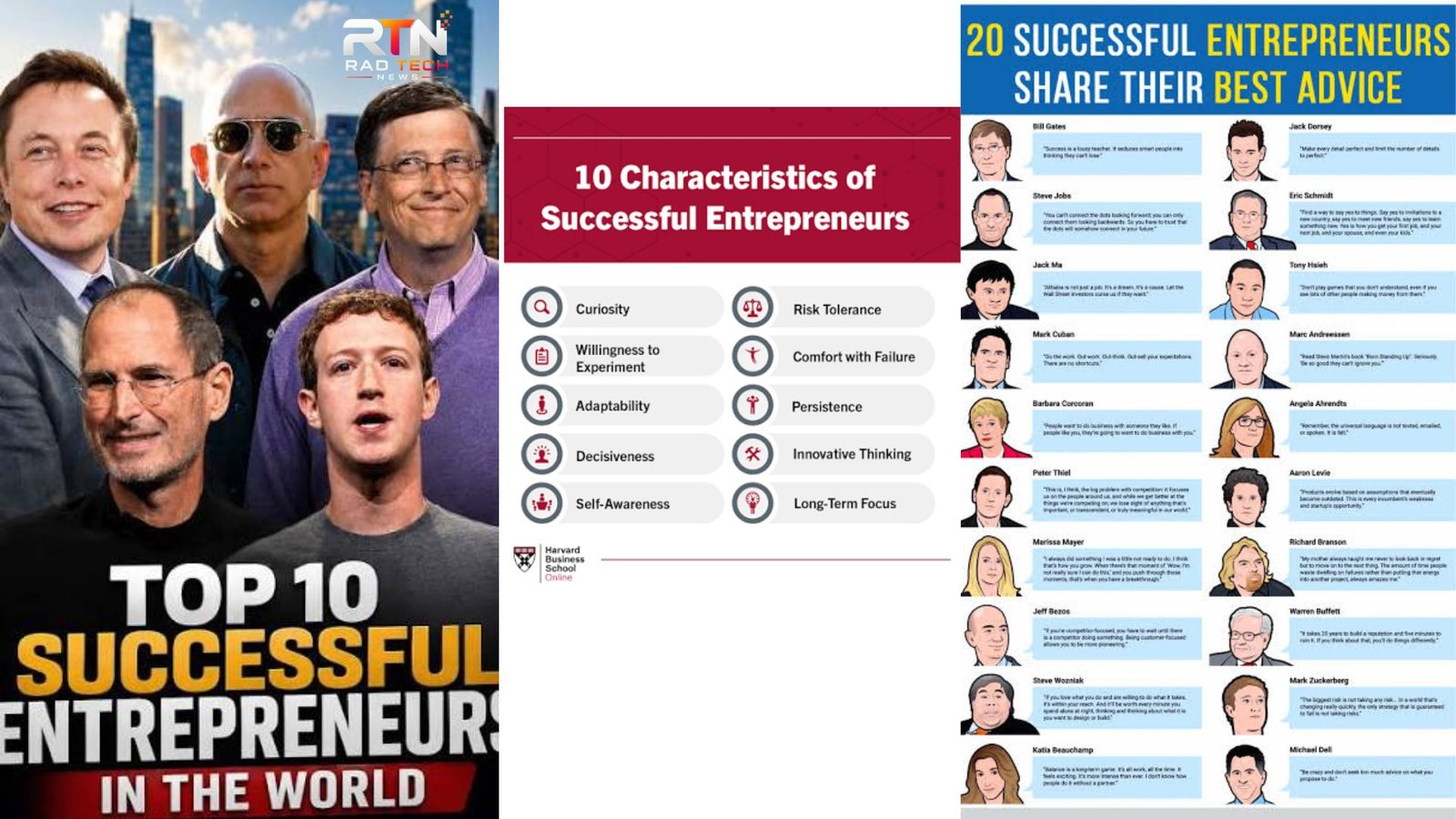
A strong entrepreneur typically combines several qualities:
- Problem recognition: Successful businesses often begin with a frustrating problem or unmet demand.
- Persistence: Valuable ideas can face rejection before customers or investors understand them.
- Adaptability: Markets change, so founders must be willing to change with them.
- Customer focus: A technically impressive product still needs to solve a problem people care about.
- Long-term thinking: Building a durable company usually requires decisions beyond immediate profits.
The examples below illustrate these qualities in very different ways.
10 Famous Entrepreneurs Worth Studying
1. Jeff Bezos — Amazon
Jeff Bezos founded Amazon in 1994, initially building the company around online book sales before expanding into a much broader technology and commerce business. His story is frequently studied for its emphasis on customer experience, experimentation, and long-term investment.
The important lesson is not simply “start an online store.” Bezos demonstrated how a company can begin with a narrow product category while developing infrastructure capable of supporting much larger ambitions.
2. Elon Musk — Tesla and SpaceX
Elon Musk has become one of the most recognizable technology entrepreneurs of the modern era through companies including Tesla and SpaceX. His approach illustrates a willingness to pursue technically difficult markets where conventional assumptions can create opportunities.
For aspiring founders, the useful takeaway is his focus on ambitious problems. However, ambition alone is not a business strategy. Complex ventures also require engineering talent, financing, operations, regulation management, and disciplined execution.
3. Bill Gates — Microsoft
Bill Gates co-founded Microsoft with Paul Allen and helped establish personal-computer software as a major commercial industry. Microsoft became especially influential through its operating systems and software products.
Gates’ entrepreneurial journey highlights the importance of understanding an emerging platform and building products that can scale with it. It also demonstrates that technical knowledge can become commercially powerful when combined with distribution and business strategy.
4. Steve Jobs — Apple
Steve Jobs is closely associated with Apple’s product philosophy, branding, and emphasis on design. His career is particularly valuable for understanding how technology companies can compete through the overall user experience rather than specifications alone.
Apple’s history also offers a less comfortable lesson: innovation is rarely a straight line. Products fail, strategies change, and leadership challenges can reshape a company before it finds its strongest direction.
5. Mark Zuckerberg — Meta
Mark Zuckerberg founded Facebook while he was a student at Harvard, and the platform later grew into the broader company now known as Meta.
His story demonstrates the enormous potential of network effects. A service becomes increasingly valuable as more people use it, creating a powerful growth mechanism. At the same time, large social platforms face substantial challenges involving privacy, content moderation, competition, and public trust.
6. Sara Blakely — SPANX
Sara Blakely created SPANX after developing a simple solution to a clothing problem. According to SPANX’s own account, she cut the feet from control-top pantyhose in 1998, then spent two years developing the concept before launching the company.
Her example is especially relevant to first-time founders because the original opportunity was ordinary and highly specific. It shows how observing a personal frustration can reveal a wider consumer need.
7. Oprah Winfrey — Harpo and OWN
Oprah Winfrey built a business career from broadcasting and expanded her influence into production, publishing, media ownership, and other ventures. Her path illustrates the commercial value of trust and a strong personal brand.
Her example also shows why audience relationships can become valuable business assets. People are more likely to engage with products, programs, or companies when they recognize a consistent voice and identity behind them.
8. Richard Branson — Virgin Group
Richard Branson founded Virgin in 1970 as a mail-order record retailer. Virgin later expanded into multiple industries, including travel, telecommunications, music, health, banking, and leisure.
Branson’s career is a useful study in branding and customer experience. The Virgin name became a platform for entering different markets while maintaining a recognizable identity. The broader lesson is that a strong brand can sometimes create opportunities beyond the company’s original product.
9. James Dyson — Dyson
James Dyson’s career demonstrates the connection between invention and entrepreneurship. Dyson’s official biography describes his development of the bagless vacuum after years of experimentation; the company says he produced 5,127 prototypes before reaching the first bagless vacuum.
His story reinforces a valuable principle: rejection does not necessarily prove that an idea has no commercial potential. Dyson was repeatedly turned down by established manufacturers before building his own company around the technology.
10. Walt Disney — Disney
Walt Disney combined storytelling, animation, character creation, merchandising, and entertainment into a business model that extended far beyond individual films. His legacy demonstrates the power of intellectual property and consistent creative identity.
For entrepreneurs, the bigger lesson is systems thinking. A successful idea can create additional opportunities when a company understands how products, experiences, characters, and audiences can reinforce one another.
💡 Pro Tip: Don’t copy a famous founder’s personality or business model. Instead, identify the underlying principle behind a success story—such as customer obsession, product differentiation, branding, or persistence—and adapt that principle to a problem you understand personally.
What Can New Entrepreneurs Learn From Them?
The most useful lessons from famous entrepreneurs are practical rather than glamorous.
First, start with a real problem. Sara Blakely’s SPANX story began with a specific clothing frustration, while James Dyson’s work was driven by dissatisfaction with existing vacuum technology.
Second, develop an advantage that customers can recognize. It might be better design, convenience, lower cost, stronger distribution, distinctive branding, or technology that competitors struggle to reproduce.
Third, expect iteration. A first product is rarely the final product. Testing, customer feedback, mistakes, and revisions are normal parts of building a business.
Finally, think beyond the initial sale. Amazon expanded far beyond books, while Virgin repeatedly entered new sectors. These examples show how an initial business can become a foundation for broader opportunities.
| Entrepreneur | Best-known venture | Core lesson |
|---|---|---|
| Jeff Bezos | Amazon | Customer focus and long-term thinking |
| Elon Musk | Tesla, SpaceX | Ambitious problem-solving |
| Bill Gates | Microsoft | Technology and scalable platforms |
| Steve Jobs | Apple | Product experience and design |
| Mark Zuckerberg | Meta | Network effects and digital platforms |
| Sara Blakely | SPANX | Solving a specific consumer problem |
| Oprah Winfrey | Harpo, OWN | Trust and personal branding |
| Richard Branson | Virgin Group | Brand expansion |
| James Dyson | Dyson | Persistence and engineering |
| Walt Disney | Disney | Creative IP and business systems |
📌 Key Takeaway: The strongest lesson from famous entrepreneurs is not that every founder should become a billionaire or build a global corporation. It is that durable businesses often emerge from solving meaningful problems, understanding customers, improving relentlessly, and building an advantage that competitors cannot easily copy.
Frequently Asked Questions
Who is the most famous entrepreneur?
There is no objective single winner because fame depends on the industry, country, and time period. Names such as Steve Jobs, Bill Gates, Jeff Bezos, Elon Musk, Richard Branson, Oprah Winfrey, and Walt Disney have achieved unusually broad public recognition through businesses and brands that affected millions of people.
What do successful entrepreneurs have in common?
Successful founders often demonstrate persistence, adaptability, customer awareness, and a willingness to make decisions despite uncertainty. Their backgrounds can be completely different, so entrepreneurial success should not be reduced to one personality type or formula.
Can someone become an entrepreneur without a lot of money?
Yes. Some businesses can be started with relatively little capital, particularly service, freelance, consulting, digital, or small product ventures. The required investment depends heavily on the business model. Starting small can also help a founder test demand before committing substantial resources.
Why is studying entrepreneurs useful?
Studying business founders can reveal how people identify opportunities, respond to failure, develop products, build brands, and scale operations. The goal should be learning principles rather than copying individual careers, because each market and founder’s circumstances are different.
Which entrepreneur is best for beginners to study?
Sara Blakely and James Dyson offer particularly accessible lessons because their stories connect everyday problems with product development and persistence. Their experiences can help beginners understand that entrepreneurship often starts with careful observation rather than a complicated business idea.
Final Thoughts
The careers of famous entrepreneurs show that there is no universal route to building a successful company. Some began with technology, others with media, retail, engineering, entertainment, or an everyday consumer problem.
The most transferable lesson is to focus less on celebrity and more on the decisions behind the success: find a genuine problem, create something useful, listen to customers, learn from setbacks, and keep improving. Those principles remain relevant whether the goal is a small business or the next global brand.
