
Digital transformation often starts with good intentions and ends with a collection of disconnected software tools.
A company buys a new CRM. Another department moves workloads to the cloud. Management introduces automation. Employees begin experimenting with AI. Six months later, leaders discover that operating costs have barely changed, customers are still frustrated, and teams are working across even more systems than before.
The problem usually is not technology. It is the absence of a clear digital transformation strategy connecting technology investments to business outcomes.
A strong strategy answers practical questions: What should be transformed first? Which technology actually matters? How should processes change? Who owns the transformation? And how will the organization know whether the investment is working?
This guide explains how digital transformation strategy frameworks help answer those questions. More importantly, it shows how to adapt those frameworks to real organizations rather than treating them as theoretical diagrams.
What Is a Digital Transformation Strategy?
A digital transformation strategy is a structured plan for using digital technology, data, new processes, and organizational change to improve how a business operates and creates value.
It goes beyond simply introducing new software.
A useful strategy normally connects five areas:
- Business objectives
- Customer experience
- Operational processes
- Technology architecture
- People and organizational capabilities
For example, replacing spreadsheets with a cloud-based CRM is digitization.
Redesigning the entire sales process so customer data flows automatically between marketing, sales, support, and management is digital transformation.
The difference is important.
Technology is only the enabling layer. The real transformation happens when workflows, decisions, customer experiences, and business models improve because of it.
Why Digital Transformation Strategies Fail
Organizations rarely fail because they cannot purchase technology.
They fail because technology is introduced without solving an important business problem.
Imagine a manufacturing company introducing an expensive analytics platform. Management expects better production planning, but machine data is incomplete, department databases use different formats, and employees still record maintenance activities manually.
The analytics software may technically work perfectly.
The transformation still fails.
Several problems appear repeatedly.
Technology Comes Before the Problem
Leadership decides, “We need AI.”
The more useful question is:
“What business decision or process would improve significantly if AI were used?”
Starting with technology encourages unnecessary projects.
Starting with business friction produces useful transformation.
Too Many Projects Start at Once
Transformation programs often launch dozens of initiatives simultaneously.
This creates:
- competing priorities
- employee fatigue
- unclear ownership
- fragmented technology
- delayed results
A smaller portfolio of high-impact initiatives usually performs better.
Employees Are Treated as End Users Instead of Participants
Processes that look efficient in a strategy presentation can be frustrating for the people actually performing the work.
Employees often understand operational bottlenecks better than executives or consultants.
Their involvement should begin during process discovery, not after the software has already been selected.
The Core Components of a Digital Transformation Strategy
Most effective digital transformation strategy frameworks eventually address similar areas.
1. Business Outcomes
Transformation should begin with measurable business goals.
Examples include:
- reducing order processing time
- improving customer retention
- lowering operational costs
- increasing conversion rates
- improving forecasting accuracy
- shortening product development cycles
“Modernize our technology” is not a useful outcome.
“Reduce customer onboarding from seven days to one day” is.
The second objective tells teams what they are actually trying to change.
2. Customer Experience
Customer journeys often reveal transformation opportunities that organizational charts hide.
Suppose a bank divides customer onboarding across marketing, compliance, sales, operations, and customer support.
Each department may believe its process works well.
From the customer’s perspective, however, onboarding might involve repeated forms, delayed approvals, and multiple requests for the same information.
Digital transformation should examine the entire journey rather than optimizing individual departments independently.
3. Processes
Many businesses make the mistake of automating inefficient processes.
That simply produces inefficient processes faster.
Before introducing automation, organizations should ask:
- Which steps add value?
- Which steps exist only because of old systems?
- Where is information entered twice?
- Where do approvals create unnecessary delays?
- Which decisions could use real-time data?
Process redesign should normally happen before automation.
4. Data
Data becomes increasingly important as businesses adopt analytics, machine learning, and generative AI.
However, transformation programs frequently underestimate data quality.
Common problems include:
- duplicated customer records
- inconsistent naming conventions
- disconnected databases
- unclear ownership
- outdated information
- incomplete tracking
An AI system built on unreliable data simply produces unreliable decisions faster.
Data governance therefore belongs inside the transformation strategy rather than being treated as an IT housekeeping task.
5. Technology Architecture
Organizations need technology that can evolve.
That often means moving away from isolated systems toward architectures that support integration through APIs, cloud services, automation platforms, and shared data environments.
But modernization does not always require replacing everything.
Sometimes integrating existing systems produces greater value than a complete technology rebuild.
The goal should be flexibility, interoperability, and business usefulness rather than technological novelty.
6. People and Culture
Transformation changes jobs.
Automation may eliminate repetitive tasks while creating new responsibilities around analysis, customer relationships, oversight, and decision-making.
Employees therefore need more than software training.
They may require new capabilities in:
- data literacy
- AI usage
- process design
- automation
- cybersecurity
- digital collaboration
Organizations that ignore this capability gap often discover that employees continue using old workflows even after expensive platforms have been introduced.
Digital Transformation Strategy Frameworks Explained
There is no single framework that fits every organization.
The best framework depends on the organization’s maturity, complexity, objectives, and transformation scope.
However, several approaches are particularly useful.
The Four-Pillar Digital Transformation Framework
A simple framework divides transformation into four pillars:
- Customer
- Operations
- Technology
- Organization
It works especially well for companies beginning their transformation journey.
Customer
Ask how technology can make customer interactions easier, faster, and more personalized.
Possible initiatives include:
- self-service portals
- personalized recommendations
- digital onboarding
- omnichannel customer support
Operations
Identify repetitive work, bottlenecks, and information gaps.
Technologies might include:
- workflow automation
- robotic process automation
- predictive maintenance
- digital inventory systems
Technology
Review whether current platforms can support the desired transformation.
Questions include:
- Can systems exchange data?
- Are applications scalable?
- Is important information trapped in legacy platforms?
- Can new technologies integrate easily?
Organization
Determine whether leadership, employees, governance, and skills support transformation.
This final pillar is often the most difficult because organizational behavior usually changes more slowly than software.
The People-Process-Technology Framework
This is one of the simplest yet most practical digital transformation strategy frameworks.
Every initiative is evaluated through three dimensions.
People
Who performs the process?
What skills do they need?
How will their responsibilities change?
Process
How does the work happen today?
Where are the delays or unnecessary steps?
What would the ideal workflow look like?
Technology
Which technology enables the improved process?
The sequence matters.
A useful rule is:
People and process should define the technology requirement, not the other way around.
Consider customer support.
Instead of buying an AI chatbot immediately, a company might first analyze the most common customer questions.
It could discover that 60% of requests occur because customers cannot see delivery status.
The better transformation may therefore be improving shipment tracking rather than installing a chatbot.
The Digital Maturity Framework
Digital maturity frameworks assess how advanced an organization is across important capabilities.
Typical maturity stages include:
- Initial
- Developing
- Defined
- Integrated
- Optimized
An organization at the initial stage might depend heavily on manual processes and disconnected systems.
An optimized organization might use integrated data, automated workflows, real-time analytics, and continuous experimentation.
The important benefit of maturity assessment is prioritization.
A company should not attempt advanced AI automation when basic data infrastructure is still unreliable.
That is similar to installing sophisticated navigation software in a vehicle with a failing engine.
The Business Capability Framework
Large organizations often benefit from organizing transformation around capabilities rather than departments.
A capability describes something the organization must be able to do.
Examples include:
- acquire customers
- manage inventory
- fulfill orders
- process payments
- forecast demand
- manage suppliers
Each capability can then be evaluated according to:
- strategic importance
- current performance
- technology maturity
- data availability
- improvement opportunity
This approach prevents transformation from becoming trapped inside organizational silos.
How to Build a Digital Transformation Strategy
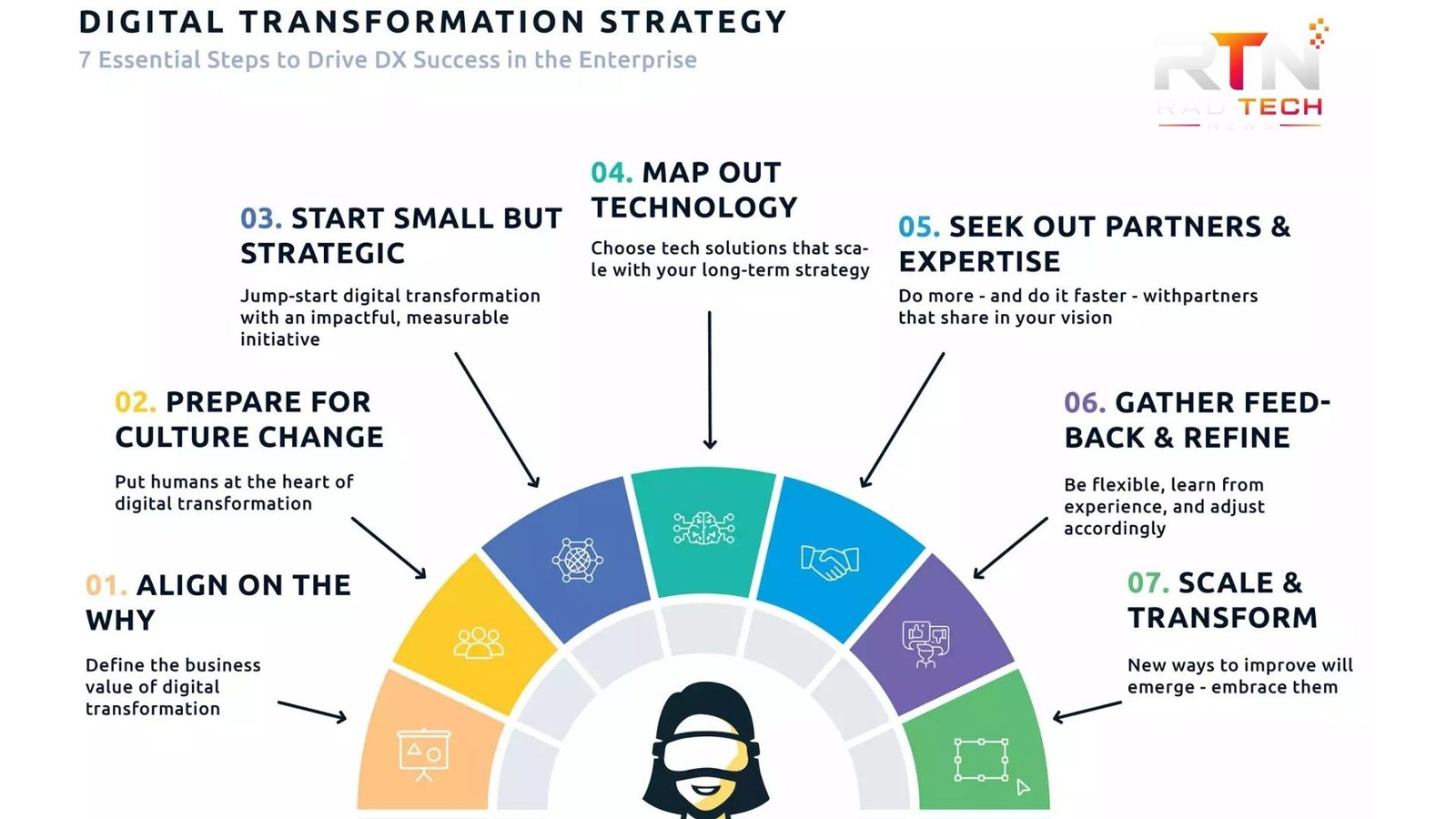
Frameworks are useful, but execution requires a clear sequence.
Step 1: Define the Business Problem
Start with measurable pain points.
Examples:
“Customer onboarding takes eight days.”
“Inventory forecasts are frequently inaccurate.”
“Sales teams spend ten hours per week entering information manually.”
Specific problems create clear transformation opportunities.
Step 2: Map the Current Journey
Document how work actually happens.
Do not rely only on official procedure documents.
Interview people doing the work.
Observe real processes.
You may discover unofficial spreadsheets, duplicate approvals, manual workarounds, and disconnected tools that management does not know exist.
Step 3: Identify the Desired Future State
Describe how the process should ideally work.
For example:
Current:
Customer submits information → employee enters information manually → another team verifies it → manager approves it → customer receives confirmation.
Future:
Customer submits structured information → system validates it automatically → exceptions are routed to employees → approval occurs digitally → confirmation is generated instantly.
Once the future workflow is clear, technology requirements become much easier to identify.
Step 4: Prioritize Initiatives
Not every transformation opportunity deserves immediate investment.
Evaluate initiatives based on factors such as:
| Factor | Question |
|---|---|
| Business value | How much financial or operational value could it create? |
| Customer impact | Will customers notice the improvement? |
| Complexity | How difficult is implementation? |
| Data readiness | Is reliable data available? |
| Time to value | How quickly can measurable benefits appear? |
| Strategic relevance | Does it support long-term business goals? |
Projects with high value and manageable complexity often make the best starting points.
Step 5: Create Ownership
Every initiative needs someone responsible for its business outcome.
Technology teams can implement systems.
They should not automatically own transformation results.
If a sales automation project fails to improve conversion rates, the project cannot be considered successful simply because the software launched on schedule.
Ownership should connect implementation with business performance.
Step 6: Measure Results
Transformation metrics should include operational or customer outcomes, not just project milestones.
Weak metrics include:
- software installed
- employees trained
- cloud migration completed
Better metrics include:
- processing time reduced by 35%
- customer abandonment reduced by 18%
- manual data entry reduced by 50%
- support response time reduced from four hours to 45 minutes
These measurements reveal whether transformation is producing real value.
A Practical Digital Transformation Example
Consider a regional retail company struggling with inventory management.
Stores frequently run out of popular products while warehouses hold excess stock of slower-moving items.
Management initially considers purchasing an AI forecasting platform.
A proper transformation process would begin differently.
First, the company investigates the workflow.
It discovers that store inventory is updated overnight, promotions are stored in a separate system, and local managers manually adjust spreadsheets before ordering stock.
The strategy therefore becomes:
- Standardize inventory data.
- Connect sales and promotion systems.
- Introduce near-real-time inventory visibility.
- Redesign replenishment workflows.
- Add predictive forecasting after reliable data becomes available.
The AI technology appears near the end rather than the beginning.
That sequence dramatically increases the probability of success.
Three Overlooked Digital Transformation Insights
Several lessons become obvious only when transformation moves from presentations into day-to-day operations.
Transformation Debt Can Become More Dangerous Than Technical Debt
Organizations often discuss technical debt, meaning outdated technology that becomes difficult to maintain.
There is also transformation debt.
It occurs when companies repeatedly introduce new digital tools without retiring old workflows.
Employees then operate the new system while maintaining spreadsheets, emails, manual approvals, or legacy platforms “just in case.”
Instead of becoming simpler, operations become more complicated.
Every transformation initiative should therefore include a question:
What old process, tool, or behavior will disappear when this goes live?
If the answer is “nothing,” the transformation may simply be adding another layer of complexity.
Speed of Learning Can Matter More Than Speed of Implementation
Management often asks how quickly a transformation can be completed.
A better question is how quickly the organization can learn whether its assumptions are correct.
Small pilots can reveal:
- user behavior
- integration problems
- data weaknesses
- process bottlenecks
- unexpected customer reactions
A three-month experiment that disproves a bad assumption can save more money than a twelve-month rollout executed perfectly.
The Best Automation Opportunities Often Appear Between Departments
Departments frequently optimize their own internal tasks.
The largest delays, however, often occur when work moves from one team to another.
For example:
Sales → Finance
Marketing → Sales
Customer Service → Operations
Procurement → Accounting
These handoffs involve emails, approvals, repeated data entry, and waiting.
Mapping cross-functional handoffs can therefore reveal transformation opportunities that ordinary department-level process reviews miss.
Common Digital Transformation Mistakes
Avoid these recurring problems.
Copying Competitors
A competitor’s technology strategy reflects its customers, systems, skills, and operating model.
Copying the technology without understanding the context can create expensive mistakes.
Measuring Activity Instead of Value
Completing 20 digital projects means little if none changes customer or financial outcomes.
Ignoring Legacy Processes
New software cannot solve every outdated policy or approval structure.
Sometimes the transformation requires changing rules rather than technology.
Underestimating Change Management
Employees need to understand why processes are changing and how those changes affect their responsibilities.
Communication should continue throughout implementation rather than appearing only during launch.
Transforming Everything
Some processes work perfectly well.
Transformation should target meaningful friction rather than changing systems simply because newer technology exists.
How AI Changes Digital Transformation Strategy
Artificial intelligence is becoming an important transformation layer, but AI should still follow business strategy.
Useful enterprise applications include:
- document processing
- customer service assistance
- forecasting
- knowledge search
- content analysis
- fraud detection
- workflow automation
- decision support
The biggest mistake is treating AI as an isolated innovation program.
Its real value often appears when AI is embedded inside existing workflows.
For example, instead of giving employees a separate AI tool, an organization might integrate AI directly into its CRM so customer history, recommendations, and next actions appear automatically during a sales conversation.
That reduces friction and increases adoption.
Frequently Asked Questions
What is the best digital transformation strategy framework?
There is no universally best framework. The People-Process-Technology model works well for individual initiatives, while digital maturity and business capability frameworks are often better for organization-wide transformation. Many companies combine elements from several frameworks rather than following one rigidly.
What are the main elements of a digital transformation strategy?
Most strategies include business goals, customer experience, process redesign, data, technology architecture, employee capabilities, governance, and performance measurement. The strongest strategies connect all of these elements instead of managing them separately.
How do you create a digital transformation strategy roadmap?
Start by identifying business problems and mapping current processes. Define the desired future state, assess organizational and data readiness, prioritize initiatives based on value and complexity, assign ownership, and establish measurable outcomes. The roadmap should be reviewed regularly as business priorities and technologies change.
What is the difference between digital strategy and digital transformation strategy?
A digital strategy describes how an organization intends to use digital capabilities to compete and create value. A digital transformation strategy focuses more specifically on changing existing processes, systems, operating models, and organizational capabilities to achieve that vision.
How long does digital transformation take?
Large-scale transformation may continue for several years because technology, customer expectations, and business models continually evolve. Individual initiatives should produce measurable results much sooner. Organizations generally benefit from treating transformation as a series of measurable improvement cycles rather than one enormous project.
Why is change management important in digital transformation?
Technology changes how people work, which can create uncertainty and resistance. Effective change management helps employees understand the reason for the transformation, develop the necessary skills, and participate in improving new workflows. Adoption determines whether technology creates value after implementation.
Conclusion
A successful digital transformation strategy is not a shopping list of cloud platforms, automation tools, analytics systems, and AI applications.
It is a business improvement strategy enabled by technology.
Digital transformation strategy frameworks provide useful structure, but the framework itself does not create results. Organizations still need to identify genuine business problems, redesign inefficient processes, improve data quality, involve employees, prioritize investments, and measure meaningful outcomes.
The most effective approach is usually incremental: solve an important problem, measure what changed, learn from the implementation, and then expand.
And one question should remain at the center of every digital initiative:
What becomes meaningfully better for the business, employee, or customer after this transformation is complete?
If that answer is clear and measurable, the technology has a purpose. If it is not, the organization probably needs to rethink the project before investing further.
