

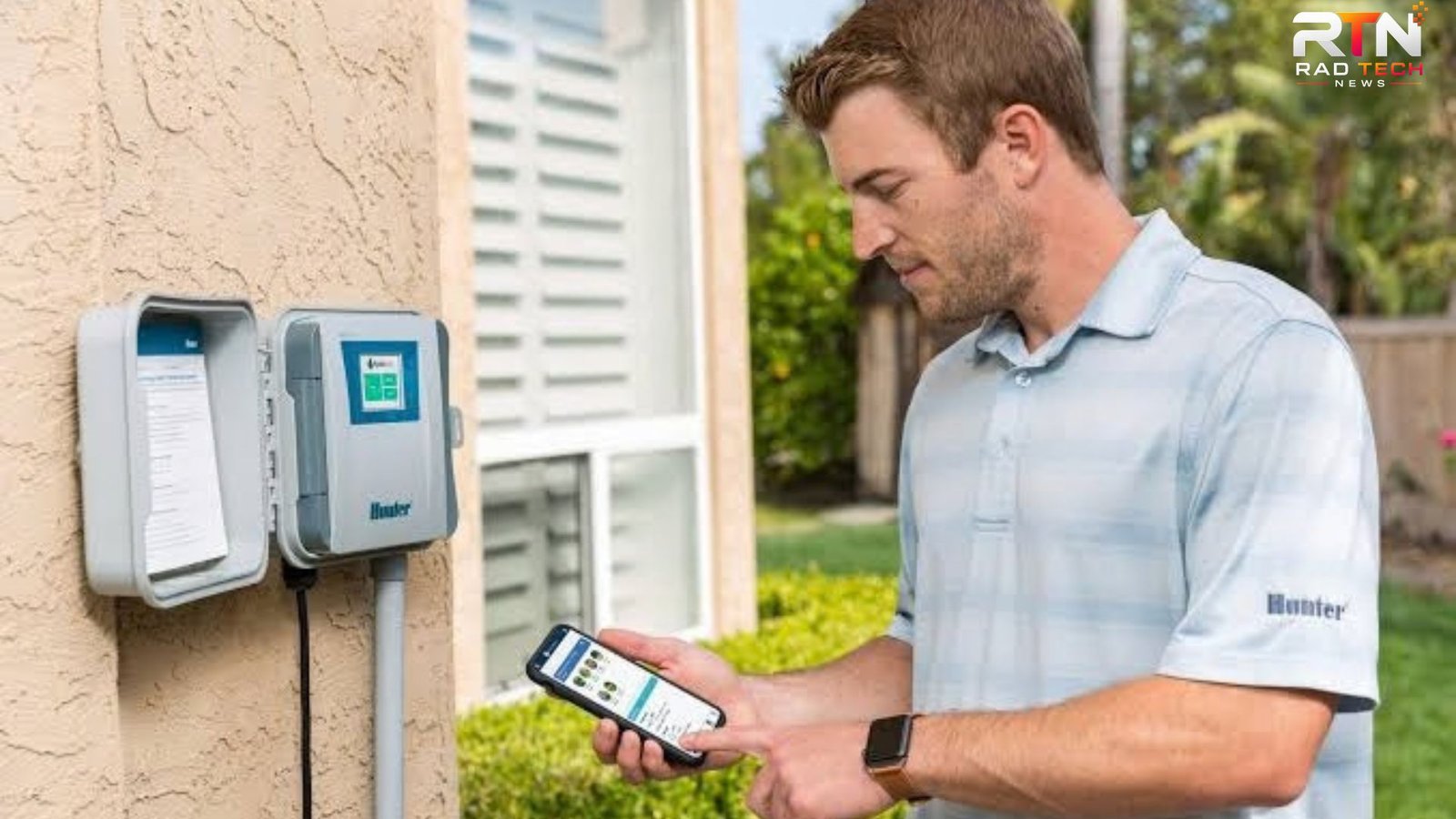
A smart irrigation controller replaces the rigid schedule of a traditional sprinkler timer with a system that can respond to actual landscape conditions. Instead of watering for the same number of minutes every week, it can adjust irrigation according to weather, soil moisture, seasonal changes, or other programmed factors.
For homeowners in the USA and UK, the technology can make lawn and garden watering more efficient while reducing the amount of manual schedule adjustment required. The right system depends on your sprinkler setup, local climate, soil, and whether you prefer weather-based automation or direct soil-moisture monitoring.
What Is a Smart Irrigation Controller?
A smart irrigation controller is an automated device that manages sprinkler or drip-irrigation schedules using information beyond a simple clock and calendar.
The two main approaches recognized by the U.S. Environmental Protection Agency’s WaterSense program are weather-based irrigation controllers and soil moisture-based irrigation controllers. Weather-based models use local weather and landscape information to determine when and how much to water, while soil moisture systems use measurements from the ground to help prevent unnecessary irrigation.
Some controllers combine both approaches. Depending on the model, connectivity may also allow homeowners to change settings, monitor watering, or receive system information through a smartphone.
How Does a Smart Irrigation Controller Work?
A conventional timer follows instructions such as “run Zone 1 for 15 minutes at 6 a.m.” A smart system can make that schedule more responsive.
A weather-based controller may consider factors such as temperature, rainfall, and other local weather conditions when adjusting irrigation. The goal is to provide water according to changing landscape requirements rather than relying on one fixed schedule throughout the season.
A soil moisture-based system takes a different approach. A sensor measures moisture in the soil and can prevent a scheduled irrigation event when the landscape already contains sufficient moisture.
The controller still needs accurate setup. Sprinkler zones, plant types, soil characteristics, sun exposure, and irrigation run times all influence performance. Smart technology cannot compensate for incorrectly installed sprinklers or poorly configured zones.
Weather-Based vs. Soil Moisture-Based Controllers
Both technologies can make irrigation more responsive, but they solve the problem in different ways.
| Feature | Weather-Based | Soil Moisture-Based |
|---|---|---|
| Main input | Local weather and landscape conditions | Moisture measured in soil |
| Scheduling approach | Adjusts watering based on changing conditions | Allows or prevents irrigation based on moisture |
| Sensor requirement | May use weather-station data or onsite sensors | Requires soil moisture sensing equipment |
| Best suited to | Landscapes affected strongly by seasonal weather | Areas where soil moisture varies significantly |
| Water-saving role | Helps reduce watering during changing weather | Helps prevent watering when soil is already moist |
The EPA notes that both types can be available as stand-alone controllers or as add-on or plug-in devices that upgrade an existing clock-based system.
Why WaterSense Certification Matters
In the USA, the EPA WaterSense label provides one useful way to evaluate irrigation-control products. WaterSense-labeled weather-based and soil moisture-based controllers are independently certified against EPA performance and efficiency requirements.
Certification does not mean every controller will perform identically in every yard. Installation, programming, sprinkler condition, and landscape design remain important.
Benefits of Smart Irrigation
The biggest advantage is adaptive watering. A fixed timer may continue operating even after rainfall, while a properly configured smart controller can adjust the schedule to changing conditions.
EPA estimates that replacing a standard clock-based controller with a WaterSense-labeled weather-based controller can save an average home nearly 7,600 gallons of water annually. For WaterSense-labeled soil moisture-based controllers, EPA reports average annual savings of more than 15,000 gallons for a home with an automatic landscape irrigation system. Actual savings vary with climate, landscape, irrigation practices, and system operation.
Other practical benefits include:
- Less manual seasonal schedule adjustment
- Better control over multiple irrigation zones
- Reduced risk of unnecessary watering
- Easier monitoring on connected models
- Greater awareness of irrigation behavior
- Potentially lower outdoor water use
These benefits are most meaningful when the underlying sprinkler system is maintained correctly.
💡 Pro Tip: Before replacing your controller, check every irrigation zone for broken heads, clogged nozzles, leaks, and overspray. A smart controller can improve scheduling, but it cannot correct water being lost through damaged equipment.
What to Consider Before Buying
Compatibility should come before features. Check how many zones your existing controller supports and whether the replacement works with your valve wiring and irrigation configuration.
Then consider the control method. A weather-based model may be convenient if you want automated schedule adjustments without installing soil sensors. A soil moisture-based system can be useful when direct measurement of ground moisture is important to your landscape.
Also look at:
- Connectivity: Wi-Fi can provide remote access, but it should not be the only reason to choose a controller.
- Sensor support: Check whether rain, flow, freeze, or soil-moisture sensors are supported.
- Watering restrictions: The controller should allow you to follow local watering rules.
- Zone flexibility: Different plants and exposure levels may require different schedules.
- Ease of setup: A complicated interface can make an otherwise capable controller difficult to manage.
- Certification: In the USA, consider products carrying the appropriate WaterSense label where applicable.
UK buyers should also check compatibility with their existing irrigation equipment and local water-use requirements rather than assuming a product designed for another market will be suitable.
Installation and Setup Tips
Replacing a controller is only part of the job. Start by documenting the existing wiring and identifying each irrigation zone before disconnecting the old unit.
After installation, configure each zone according to its actual landscape conditions. A lawn exposed to full sun may have different watering requirements from a shaded planting bed. Likewise, drip irrigation should not necessarily be programmed like spray sprinklers.
Run each zone and inspect the coverage. Look for pooling, runoff, blocked areas, and overspray onto sidewalks or driveways. Then monitor the landscape and make small adjustments rather than assuming the manufacturer’s default settings are perfect.
A smart irrigation controller should support good irrigation management—not replace it.
📌 Key Takeaway: The best controller is not necessarily the one with the most features. Choose technology that matches your irrigation system, then configure each zone accurately and maintain the sprinklers. Weather-based and soil moisture-based systems can both improve watering efficiency when correctly installed and operated.
Frequently Asked Questions
Are smart irrigation controllers worth it?
They can be worthwhile for properties with automatic sprinkler systems, particularly when schedules are frequently affected by changing weather or seasonal conditions. The value depends on the existing system, controller cost, installation requirements, and how much water can be saved through better scheduling.
Does a smart irrigation controller save water?
It can. Weather-based systems adjust watering using local weather and landscape conditions, while soil moisture-based systems can prevent irrigation when the soil already has sufficient moisture. EPA identifies both technologies as water-efficient alternatives to conventional clock-based scheduling.
Can I use one with my existing sprinkler system?
Many smart controllers are designed to replace conventional controllers or work as add-on devices. However, compatibility depends on the number of zones, valve wiring, power requirements, sensors, and the specific irrigation equipment already installed. Check the manufacturer’s compatibility information before purchasing.
Is weather-based or soil moisture-based irrigation better?
Neither approach is universally better. Weather-based controllers respond to environmental and landscape conditions, while soil moisture systems measure moisture directly in the ground. Your soil, plants, climate, irrigation design, and installation options should determine which approach makes more sense.
Does a smart controller need Wi-Fi?
Not necessarily. Some controllers can operate without continuous internet connectivity, while connected models use Wi-Fi for remote management and access to online weather information. If internet connectivity is important to your chosen model, check what happens to scheduled irrigation when the connection is unavailable.
Conclusion
A smart irrigation controller can turn a basic sprinkler timer into a more responsive watering system. Weather-based models adjust schedules using changing environmental conditions, while soil moisture-based technology uses moisture readings to help prevent unnecessary watering.
For a new installation or controller replacement, focus first on compatibility, zone setup, sensor technology, certification, and ease of management. With correct installation and regular maintenance, the right smart irrigation controller can make landscape watering more precise without making the system unnecessarily complicated.
