

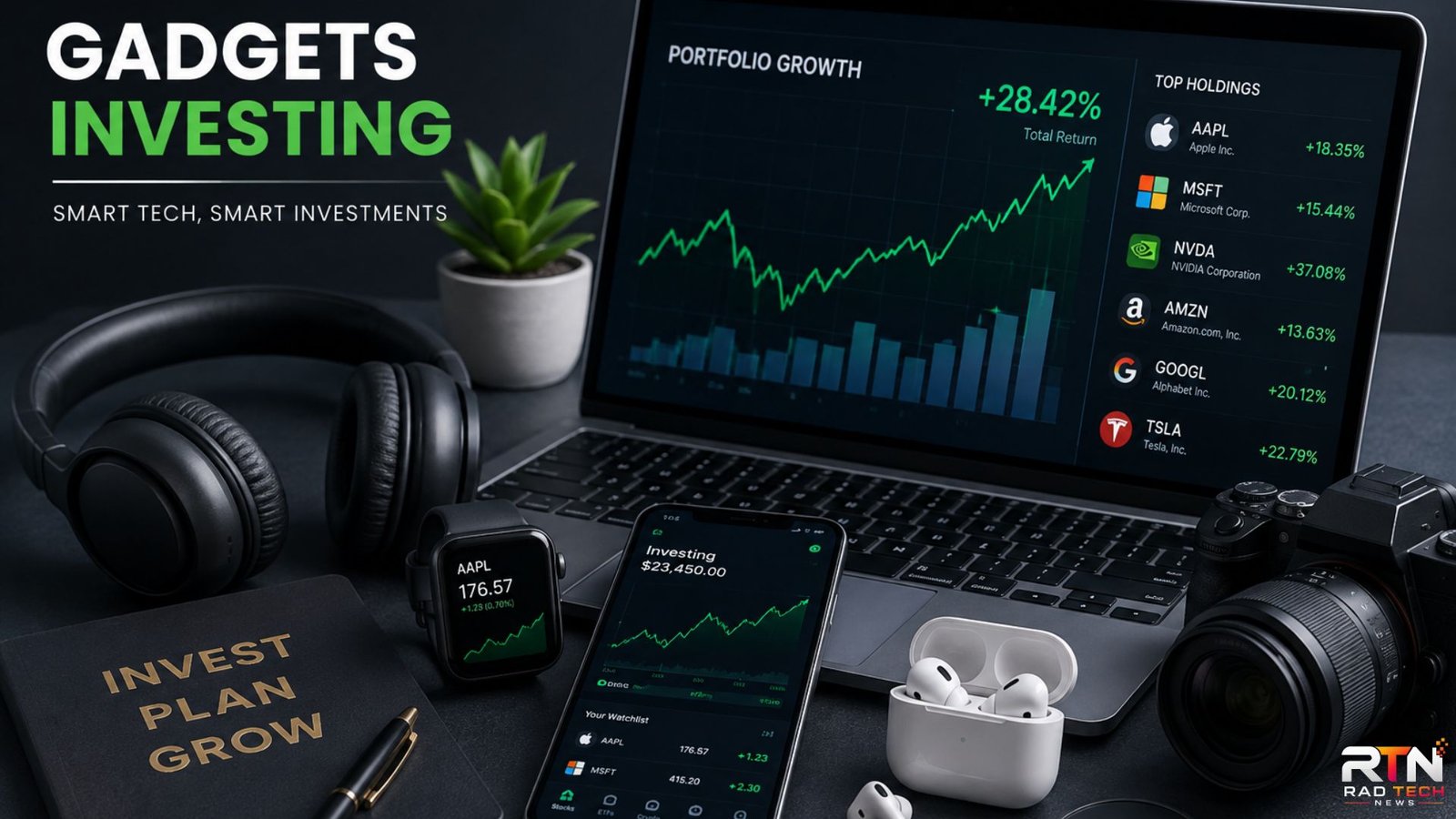
The gadget market moves quickly. One year, a particular type of smartwatch is everywhere; the next, buyers have moved on to AI devices, smart home equipment, wearable health technology, or a new generation of gaming hardware. That creates an interesting opportunity for people interested in gadgets investing, but it also creates a common trap: confusing a popular gadget with a good investment.
Investing in gadgets is not simply about buying the newest phone, laptop, or smart device and hoping its value rises. Most consumer electronics depreciate, often quickly. The more useful approach is to invest in the businesses, technologies, components, platforms, and trends surrounding gadgets rather than treating the physical device itself like a traditional investment asset.
What Does Gadgets Investing Actually Mean?
Gadgets investing can refer to several different strategies, and understanding the distinction is important.
The first is investing in companies that make gadgets. This could include manufacturers of smartphones, computers, wearables, gaming hardware, cameras, smart home products, or other consumer electronics.
The second is investing in the technology ecosystem behind gadgets. Semiconductor manufacturers, chip designers, display suppliers, battery companies, connectivity providers, and software businesses can all benefit from increasing gadget adoption.
The third approach involves buying and reselling physical gadgets. A person might purchase limited-edition electronics, discontinued devices, refurbished products, or collectible technology with the intention of selling them later.
These approaches have completely different risk profiles.
A physical gadget can lose value as soon as a newer model appears. A profitable technology company, however, may continue generating revenue from several product generations.
That distinction is one of the most important concepts for anyone entering this area.
Why Gadgets Can Create Investment Opportunities
Consumer electronics are more than physical products. They represent a chain of businesses.
Consider a modern smartphone. Its final selling price supports an ecosystem involving:
- Semiconductor designers and manufacturers
- Display producers
- Camera and sensor suppliers
- Battery and power-management companies
- Operating-system developers
- Cloud service providers
- Accessories manufacturers
- Retailers and distributors
- Repair and refurbishment businesses
A successful gadget can therefore create economic value far beyond the company whose logo appears on the device.
This is where experienced investors often look beyond the obvious brand.
Instead of asking, “Which gadget will become popular?” a better question is:
“Which businesses are positioned to benefit if this category grows?”
That shift can produce a much more durable investment thesis.
The Main Ways to Invest in the Gadget Industry
1. Investing in Gadget Manufacturers
The most straightforward strategy is buying shares of established consumer technology companies.
Investors typically examine:
- Revenue growth
- Profit margins
- Cash flow
- Product demand
- Market share
- Research and development spending
- Brand strength
- Customer loyalty
- Competitive advantages
However, a popular product does not automatically make its manufacturer an attractive investment.
A company can sell millions of devices while facing shrinking margins, rising production costs, or intense competition.
The financial health of the company matters more than the excitement surrounding one product.
2. Investing in Semiconductor Companies
Chips are effectively the nervous system of modern electronics.
Smartphones, laptops, gaming consoles, smart appliances, cameras, cars, and AI-enabled devices all depend on semiconductors.
This creates an interesting way to gain exposure to gadget growth without betting on a particular consumer brand.
The downside is that semiconductor businesses can be cyclical. Demand may surge during technology upgrades and weaken when manufacturers accumulate excess inventory.
Therefore, investors should examine the broader semiconductor cycle rather than assuming that rising gadget sales will always translate into rising chip-company profits.
3. Investing in Emerging Gadget Categories
Another approach is identifying technology categories before they become mainstream.
Examples include:
- AI-powered consumer devices
- Smart glasses
- Advanced wearables
- Home robotics
- Gaming hardware
- Smart home systems
- Portable computing
- Connected health devices
- Next-generation batteries
The opportunity can be substantial, but so can the failure rate.
Many supposedly revolutionary gadgets never achieve mass adoption.
An experienced approach is to watch actual consumer behavior, not just product announcements.
If customers repeatedly purchase a technology, recommend it to others, and incorporate it into daily routines, that is more meaningful than a large marketing campaign.
How to Evaluate a Gadget Investment
Before investing, use a structured process rather than relying on excitement.
Step 1: Identify the Consumer Problem
Start with the problem the gadget solves.
For example, a device that saves time, improves productivity, reduces friction, or provides an experience users genuinely value has a stronger foundation than a product whose main attraction is novelty.
Ask:
Would customers still want this product if the marketing disappeared?
If the answer is no, be cautious.
Step 2: Examine Adoption
Sales growth matters, but adoption quality matters too.
Look for signs such as:
- Repeat purchases
- Strong customer retention
- Expanding use cases
- Growing developer support
- Increasing ecosystem compatibility
- Positive long-term customer behavior
A gadget with a small but highly loyal customer base may eventually become more valuable than a product that experiences one short-lived viral moment.
Step 3: Study the Competitive Landscape
Technology markets rarely remain uncontested.
If a company develops a successful product category, competitors will usually attempt to copy or improve it.
Look at:
- Number of competitors
- Switching costs
- Patents and intellectual property
- Manufacturing capabilities
- Distribution
- Brand loyalty
- Software ecosystem
- Pricing power
A strong ecosystem can be particularly valuable because customers may hesitate to leave when their accessories, applications, subscriptions, and other devices are interconnected.
A Simple Comparison: Gadget vs. Gadget Company
Suppose you have $1,000 and believe a particular new device will become popular.
You could purchase several units and hope to resell them later.
Or you could research the companies that manufacture the device and the components required to produce it.
The physical-device strategy has several problems:
- Inventory can become obsolete.
- Prices can fall rapidly.
- Batteries degrade.
- New models can reduce demand.
- Warranty problems can eliminate profits.
- Storage and shipping create costs.
An investment in a business has a different set of risks, but the company can potentially earn money from many products and customers.
This does not mean company shares are automatically safer. It simply means the underlying economics are different.
Three Overlooked Insights About Gadget Investing
The Accessories Can Reveal Product Strength
One underappreciated signal is the accessory ecosystem.
If customers are willing to purchase cases, docks, chargers, keyboards, replacement parts, subscriptions, or other complementary products, that can indicate deeper engagement with the underlying device.
Accessories are not just additional sales. They can reveal whether a gadget has become part of a customer’s routine.
Repairability Can Affect Long-Term Value
Investors often focus on launch-day sales and overlook what happens afterward.
Products that are easier to repair, upgrade, refurbish, or resell may develop healthier secondary markets.
This matters because a strong refurbishment ecosystem can extend the economic life of a product and create additional businesses around it.
The Real Moat May Be Outside the Gadget
A device itself can be copied.
An ecosystem is harder to copy.
If customers are connected through software, subscriptions, cloud services, accessories, applications, and multiple devices, the company’s competitive advantage may come from the entire network rather than from the physical gadget.
This is one reason investors should analyze the ecosystem instead of judging a technology company solely by its latest hardware release.
Common Mistakes Beginners Make
Chasing Viral Gadgets
Social media attention is not the same thing as sustainable demand.
A gadget can generate millions of views without becoming a profitable long-term business.
Assuming Innovation Equals Profit
A technically impressive product can still fail commercially.
Manufacturing costs, pricing, distribution, customer education, and competition can determine whether innovation turns into profit.
Ignoring Valuation
Even an excellent company can become an unattractive investment if investors pay an excessive price for its shares.
Strong business does not always mean strong investment at every valuation.
Betting Everything on One Trend
Putting an entire portfolio into one emerging technology creates unnecessary concentration risk.
Technology changes too quickly to assume that today’s leading category will dominate tomorrow.
How Beginners Can Build a Gadget-Focused Strategy
A sensible starting process could look like this:
- Choose a technology area you understand.
- Identify several companies benefiting from that trend.
- Compare their financial performance.
- Research their competitors.
- Examine how durable customer demand appears.
- Consider valuation rather than popularity alone.
- Diversify rather than relying on one company.
- Review the investment thesis periodically.
You do not need to predict the next revolutionary gadget perfectly.
In fact, trying to predict the single winning product can be less productive than identifying a broad trend and finding several businesses positioned to benefit from it.
Physical Gadget Reselling as an Alternative
Some people use “gadgets investing” to mean buying electronics for future resale.
This can work, but it is closer to inventory-based trading than conventional investing.
Potential opportunities include:
- Discontinued electronics
- Limited production models
- Vintage technology
- Refurbished devices
- Hard-to-find accessories
- Collectible gaming hardware
The key calculation is not simply purchase price versus expected selling price.
You also need to account for:
Net profit = Selling price − purchase cost − marketplace fees − shipping − repairs − storage − taxes
A gadget that appears to offer a $100 profit may provide very little actual return after these costs.
How to Manage Risk
Technology investing requires discipline because innovation creates uncertainty.
Consider diversification across:
- Different technology categories
- Different companies
- Hardware and software
- Established businesses and emerging opportunities
- Different geographic markets
It is also useful to maintain a written investment thesis.
For example:
“I believe demand for this technology will increase because adoption is expanding, production economics are improving, and the company has a defensible ecosystem.”
Then define what would prove that thesis wrong.
This simple habit can prevent emotional decisions when a stock falls or a new competitor appears.
What Should You Research Before Buying?
Before committing money, investigate five areas.
Business Fundamentals
Understand how the company actually makes money.
Product Demand
Look beyond advertisements and examine whether customers are genuinely adopting the product.
Financial Position
Debt, cash flow, margins, and profitability can matter more than headline sales.
Competition
Ask what prevents another company from offering a cheaper or better alternative.
Valuation
A great company can still be overpriced.
These five areas provide a much stronger foundation than choosing investments based on product hype.
Frequently Asked Questions
Is gadgets investing profitable?
It can be, but profitability is never guaranteed. The strongest opportunities usually come from understanding the businesses and technologies behind consumer electronics rather than simply purchasing popular gadgets. Research, diversification, valuation, and risk management remain essential.
What are the best gadgets to invest in?
There is no single gadget that is guaranteed to perform well as an investment. Instead, look for categories with genuine consumer demand, expanding use cases, strong ecosystems, and sustainable business economics. Investors should evaluate the companies and technologies connected to those categories.
Can I invest in gadgets without buying stocks?
Yes. Some people buy and resell physical electronics, collectible devices, discontinued products, or refurbished gadgets. However, this requires inventory management and involves risks such as depreciation, damaged products, marketplace fees, and changing consumer demand.
Is investing in technology companies better than buying gadgets?
For most traditional investors, publicly traded companies provide a more conventional investment structure than physical gadgets. A gadget can lose value rapidly as newer models appear, while a company can generate revenue from multiple products and services. Both approaches carry risk, so the right choice depends on the investor’s objectives and expertise.
How do I identify promising technology trends?
Look for evidence of sustained adoption rather than temporary hype. Pay attention to repeat purchases, expanding applications, ecosystem development, improving economics, and whether customers are incorporating the technology into everyday life.
Conclusion
Gadgets investing becomes much easier to understand once you stop looking only at the device itself.
The most interesting opportunities may sit behind the product: semiconductor companies, component manufacturers, software platforms, ecosystem providers, retailers, repair networks, and businesses that enable the technology to reach consumers.
For physical gadget reselling, the calculation is different. Depreciation, inventory costs, resale demand, and transaction fees can determine whether an apparently attractive deal actually produces a worthwhile return.
