

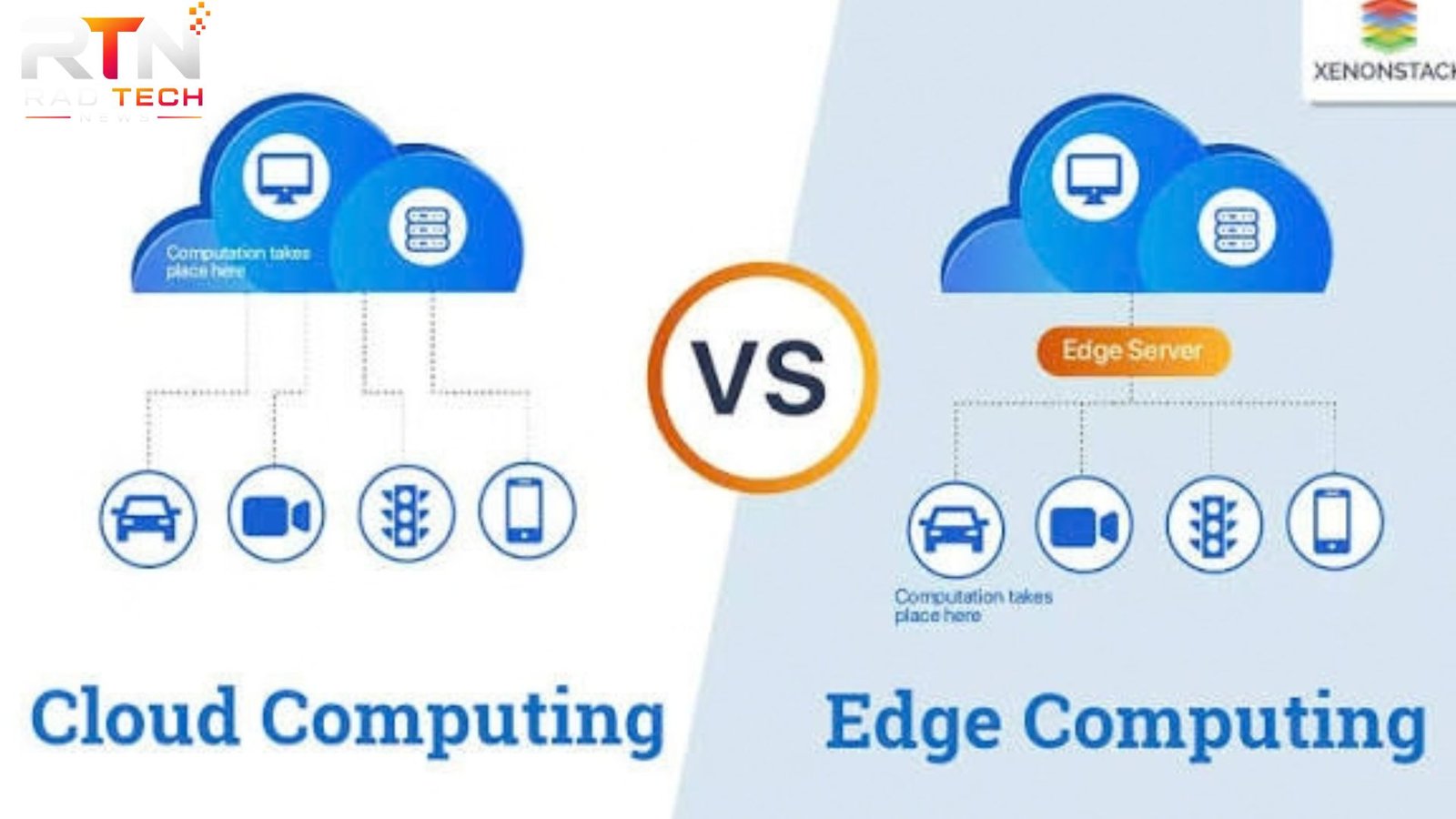
Edge computing vs cloud computing is not simply a choice between two competing technologies. The two approaches place computing resources in different locations and solve different technical problems. Cloud computing centralizes infrastructure in provider-managed data centers, while edge computing moves processing closer to devices, users, or data sources.
The right architecture depends on factors such as latency requirements, connectivity, data volume, scalability, security, and where applications need to operate. In many modern systems, edge and cloud computing work together rather than replacing one another.
What Is Edge Computing?
Edge computing processes data close to where that data is generated or consumed. Instead of sending every request to a distant data center, an organization can use local devices, gateways, on-premises servers, micro data centers, or geographically distributed edge infrastructure.
This approach can reduce network latency and bandwidth consumption. It is particularly useful when applications need rapid responses or must continue operating despite unreliable connectivity. AWS describes edge computing as bringing storage and computing capabilities closer to devices and users. Amazon Web Services, Inc.+1
Common examples include:
- Industrial machines analyzing sensor data locally.
- Retail systems processing information at individual stores.
- Connected vehicles making decisions with limited network dependence.
- Security cameras performing local video analysis.
- Content delivery infrastructure serving data closer to end users.
Edge computing does not necessarily eliminate the cloud. Local systems can process time-sensitive information and send selected results to centralized cloud platforms for storage, broader analytics, model training, or management.
What Is Cloud Computing?
Cloud computing provides computing resources through a network rather than requiring an organization to operate all of its own physical infrastructure. NIST defines cloud computing as on-demand network access to a shared pool of configurable resources that can be rapidly provisioned and released with limited management effort. NIST+1
Cloud platforms commonly provide:
- Virtual machines and containers
- Object and block storage
- Managed databases
- Networking services
- Analytics platforms
- Artificial intelligence and machine learning services
- Application development tools
The cloud is particularly valuable when workloads require substantial computing capacity, centralized management, rapid scaling, or access from many locations. Cloud providers also handle much of the underlying hardware infrastructure, allowing organizations to provision resources without building and maintaining equivalent data centers themselves. AWS Documentation
Edge Computing vs Cloud Computing: Key Differences
The central distinction in edge computing vs cloud computing is location. Edge infrastructure operates closer to the source of data or the end user, while traditional cloud workloads commonly run in centralized provider data centers.
| Factor | Edge Computing | Cloud Computing |
|---|---|---|
| Processing location | Near devices, users, or data sources | Centralized or regional cloud data centers |
| Latency | Typically lower for local processing | Depends on network distance and connectivity |
| Connectivity | Can continue operating with limited connectivity | Usually depends more heavily on network access |
| Scalability | Distributed and often workload-specific | Highly scalable through centralized resources |
| Data handling | Can filter or analyze data locally | Centralizes large-scale processing and storage |
| Management | More distributed infrastructure | Centralized provider-managed infrastructure |
| Typical uses | IoT, industrial control, real-time applications | Web apps, databases, analytics, enterprise workloads |
The difference is therefore architectural rather than absolute. Cloud providers increasingly offer services that place computing resources closer to customers, while edge environments can remain connected to centralized cloud services.
When Should You Use Edge Computing?
Edge computing becomes particularly useful when milliseconds matter, connectivity is inconsistent, or sending all raw data to a centralized platform would be inefficient.
Manufacturing provides a practical example. A machine-monitoring system may need to detect an abnormal condition and respond immediately. Sending every sensor reading to a distant cloud endpoint can introduce unnecessary network dependency. Processing critical information locally can support faster responses, while the cloud can retain historical data for deeper analysis.
Other suitable scenarios include autonomous systems, telecommunications, smart infrastructure, remote facilities, augmented or virtual reality, and real-time video processing.
💡 Pro Tip: Design edge workloads around the data that genuinely requires an immediate local response. Keep centralized analytics, long-term storage, model training, and fleet management in the cloud when those functions do not require local execution.
When Is Cloud Computing the Better Fit?
Cloud infrastructure is often appropriate when applications need centralized administration, substantial storage, elastic capacity, or sophisticated managed services.
For example, an online retailer may use cloud infrastructure for its application servers, databases, analytics, backups, and development environments. These workloads can benefit from centralized infrastructure and the ability to provision resources as demand changes.
Cloud computing also simplifies access to specialized services. Instead of deploying every database, analytics platform, or machine learning environment independently, teams can consume managed services through a cloud provider.
That makes cloud architecture attractive for applications where ultra-low local latency is not the primary requirement.
Why Many Organizations Combine Both
A common misconception about edge computing vs cloud computing is that an organization must choose one architecture. In practice, hybrid designs can divide workloads according to their requirements.
An edge device might collect and preprocess sensor information, discard unnecessary data, and send important events to a cloud platform. The cloud can then store historical information, run large-scale analytics, train machine learning models, and provide centralized dashboards.
Microsoft similarly describes edge infrastructure as a way to run workloads closer to where data is created while maintaining cloud-based management and integration. Microsoft Azure
This division can reduce unnecessary network traffic without giving up centralized capabilities.
Security and Cost Considerations
Security requires careful architectural planning in both models. Centralized cloud environments can simplify some aspects of infrastructure management, while distributed edge environments create more locations, devices, and connections that must be protected and monitored.
Cost also depends heavily on the workload. Edge infrastructure may reduce bandwidth requirements and support local processing, but organizations may need to purchase, deploy, maintain, and secure equipment across many locations. Cloud services can reduce hardware ownership but introduce recurring infrastructure, storage, compute, and data-transfer costs.
For that reason, comparing headline pricing alone can produce misleading results. Organizations should evaluate the complete operating model, including hardware, networking, administration, security, maintenance, and data movement.
📌 Key Takeaway: Edge computing is mainly about moving computation closer to where data is created or consumed. Cloud computing provides centralized, scalable computing resources. For many applications, the most practical architecture combines local processing with centralized cloud services.
Frequently Asked Questions
Is edge computing faster than cloud computing?
Edge computing can provide lower latency when processing occurs close to the device or user, because data may not need to travel to a distant data center. The actual performance depends on the network, hardware, workload, and architecture. AWS notes that edge processing can support latency-sensitive applications and faster local responses. Amazon Web Services, Inc.
Can edge computing work without the cloud?
Yes. Some edge applications can operate independently for periods of time, particularly when local processing and storage are sufficient. However, many production architectures use both approaches. Edge systems can continue essential operations locally while synchronizing selected data with centralized cloud infrastructure when connectivity is available.
Is edge computing more expensive than cloud computing?
There is no universal answer. Edge deployments can require additional hardware, maintenance, security controls, and distributed management. Cloud platforms can reduce infrastructure ownership but create ongoing usage and data-transfer expenses. The appropriate comparison should consider the entire lifecycle cost of the workload rather than infrastructure price alone.
What are common examples of edge computing?
Examples include industrial IoT systems, local video analytics, connected vehicles, smart retail equipment, telecommunications infrastructure, and applications operating at remote sites. These environments can benefit when data needs to be processed locally because of latency, bandwidth, reliability, or operational requirements.
Do businesses have to choose between edge and cloud computing?
No. Hybrid architectures are common because the technologies address different requirements. Edge infrastructure can handle immediate local processing, while cloud platforms provide centralized storage, analytics, application services, and management. The workload can therefore be divided according to latency, connectivity, data, and scalability requirements.
Conclusion
The practical question behind edge computing vs cloud computing is where each part of an application should run. Edge architecture makes sense when local processing, low latency, bandwidth efficiency, or operation during connectivity problems is important. Cloud architecture remains valuable for centralized services, elastic resources, large-scale storage, analytics, and managed infrastructure.
For many organizations, the strongest architecture is not exclusively edge or cloud. A carefully designed combination can process urgent data locally while using cloud infrastructure for centralized intelligence, storage, and management.
